
Defining the Standard: XR Stage Dimensions and Benchmarks
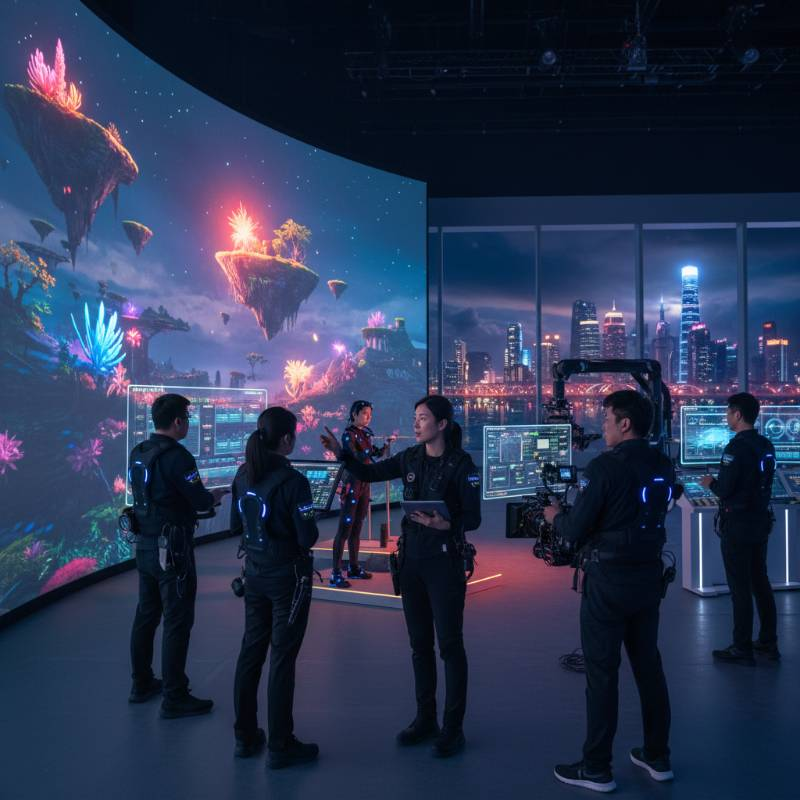
Designing an XR volume requires more than just buying panels; it demands precision engineering. In 2026, a standard commercial-grade virtual production led wall size typically encompasses a diameter of 10 to 15 meters and a height of 4 to 6 meters.
These dimensions provide a total surface area exceeding 150 square meters, allowing for multi-camera setups and diverse lens choices. To ensure flicker-free performance with high-speed shutters, a 7680Hz refresh rate is the baseline requirement for modern XR stage dimensions.
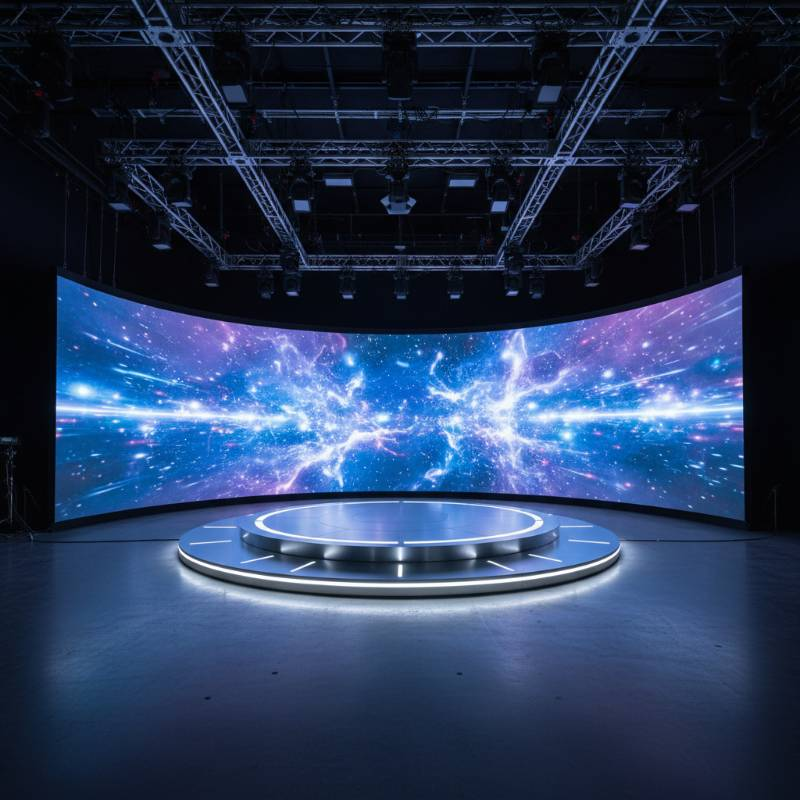
Proper sizing ensures that the "sweet spot"—the area where the camera can move freely without breaking the illusion—is maximized. This involves integrating high-performance LED Panel Hardware Comparison metrics to ensure the hardware supports the creative vision.
The Geometry of Immersion: Calculating Radius and Height
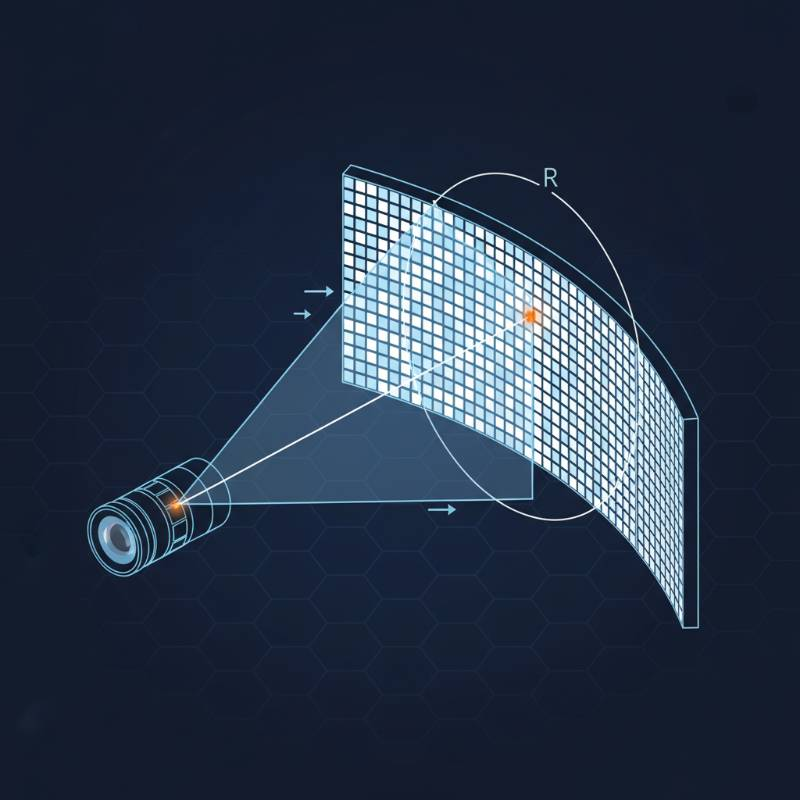
Determining the curve radius for virtual production is a trigonometric exercise. The relationship between the camera’s Field of View (FOV), the shooting distance, and the LED volume radius dictates the "viewing frustum" efficiency.
"The ideal LED volume radius is derived by ensuring the screen remains outside the lens's minimum focus distance while staying within the 'moiré-free' zone of the pixel pitch."
If the radius is too tight, the camera's FOV will capture the edges of the wall. If it is too wide, you waste megapixel capacity and increase costs. For a standard 35mm lens, a radius of 5–7 meters typically allows for comfortable movement without the background losing its immersive perspective.
Height is equally critical. A 6-meter wall height is often necessary to prevent the camera from "shooting off" the top of the wall during low-angle shots. This is a core component of comprehensive Virtual Production Studio Design.
Pixel Pitch Selection: The P1.9 to P2.6 Golden Standard
For 2026, the P1.9 pixel pitch and P2.6 LED panels have emerged as the industry sweet spot. This range balances high-resolution detail with the budget constraints of large-scale builds.
The primary goal is moiré pattern suppression. Moiré occurs when the camera's sensor grid conflicts with the LED pixel grid. By choosing a tighter pitch, you decrease the "Moiré Vanishing Point"—the distance at which the camera can focus on the talent without seeing the pixels behind them.
| Pixel Pitch (mm) | Min. Camera Distance (m) | Resolution per Sqm |
|---|---|---|
| P1.5 | ~3.5m | 444,444 |
| P1.9 | ~4.5m | 277,008 |
| P2.6 | ~6.0m | 147,456 |
The Spatial-Sync Sizing Protocol
We utilize a proprietary Spatial-Sync Sizing Protocol to ensure every panel serves a purpose. This three-step framework aligns physical stage footprints with digital requirements to maximize ROI.
Frustum Mapping: We simulate the camera's maximum movement range within Unreal Engine to define the minimum active LED area.
Pixel Density Alignment: We match the LED wall's bit depth and scan rate to the camera’s global shutter speed.
Hardware Scaling: We calculate the exact megapixel capacity required for Brompton processing or NVIDIA RTX clusters to avoid over-speccing.
Ceiling Screen Logic: Lighting and Reflection Integration
The LED sky panel or ceiling screen is not just for visuals—it is a sophisticated lighting tool. The ceiling screen dimensions must be large enough to cover all possible reflection angles on shiny surfaces, such as car paint or glass.
In a standard ICVFX light wrap, the ceiling provides the ambient lighting that grounds the talent in the digital environment. Without a properly sized ceiling, the lighting on the actor will look "flat" compared to the high-dynamic-range background of the main wall.
For more on how these components work together, see our guide on ICVFX Workflow Integration.
Technical Compliance: Unreal Engine and ARRI Standards
To achieve professional results, your LED volume must adhere to Epic Games display standards. This includes rigorous testing for color uniformity and latency. Modern stages utilize SMPTE ST 2110 for uncompressed IP video transport, ensuring the lowest possible glass-to-glass latency.
Furthermore, synchronization with ARRI Rec.2020 color space is vital. When the LED wall and the camera share the same color gamut, the "In-Camera VFX" (ICVFX) looks seamless, requiring minimal post-production color grading.
Reference: ARRI Color Science Documentation
Hollywood Insights: Scaling for High-End Production
We spoke with a veteran Technical Director who has worked on major Disney+ and HBO productions. His advice for those planning a new studio is clear: "Don't build for the shot you have today; build for the movement you'll want tomorrow."
"Many studios fail because they underestimate the floor space needed for the camera dolly and the jib. Your LED volume size is only half the battle; the physical clearance around it is what allows for cinematic scale."
Plan Your XR Studio with Experts
Ready to define your stage's footprint? Book a 1-on-1 XR studio dimensions and budget planning session with our technical team today.
Schedule Your ConsultationFrequently Asked Questions
Is there an LED volume size calculator?
While basic calculators exist, professional builds require a custom frustum analysis based on your specific camera sensor and lens kit. We provide this as part of our consultation services.
How do large volumes affect XR stage acoustics?
Large LED walls are highly reflective surfaces. Professional stages must incorporate acoustic dampening behind the LED structure and on the studio floor to prevent echo during dialogue recording.
What media server is needed for a 150sqm wall?
A wall of this size typically requires a multi-node cluster of servers, such as Disguise vx4+ or custom NVIDIA RTX 6000 Ada workstations, to handle the massive pixel throughput and real-time Unreal Engine rendering.