
Custom Transparent LED Displays: Engineering Architectural Vision
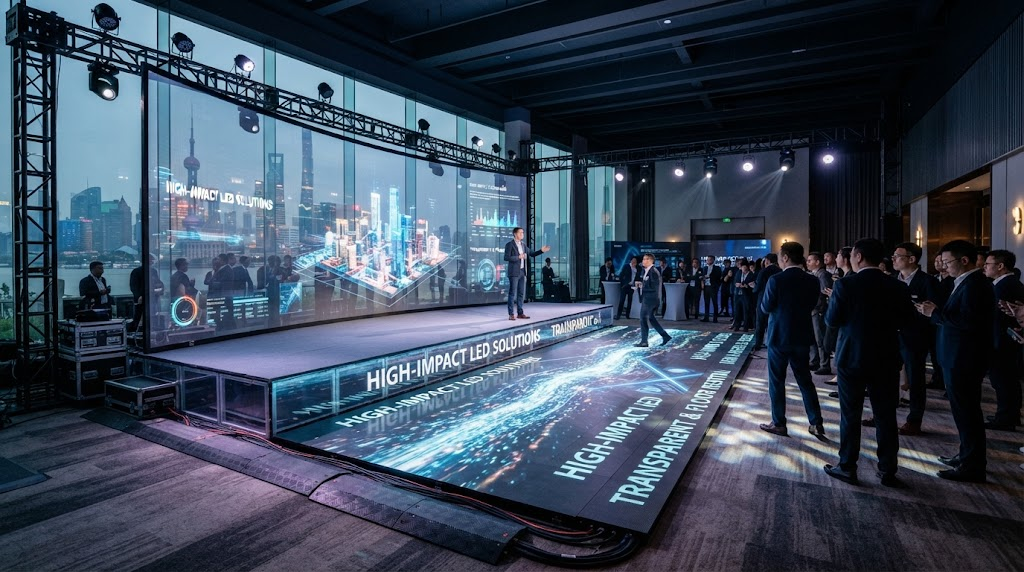
Architectural design in 2026 demands the dissolution of boundaries between digital media and physical structures. At Guanhong Display, we specialize in custom transparent LED solutions that transform static glass surfaces into dynamic storytelling canvases without compromising structural transparency.
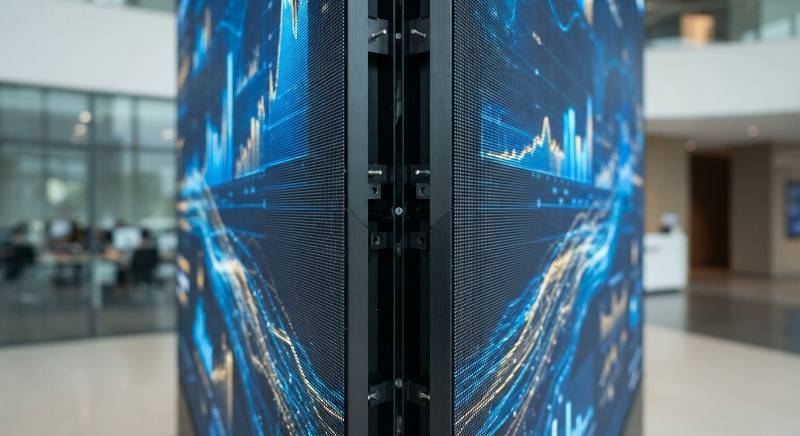
Integrating digital signage into complex geometries—such as curved facades or cylindrical atriums—requires more than just standard hardware. It necessitates a deep understanding of SMD technology, structural load-bearing, and precision manufacturing to ensure every pixel aligns perfectly across irregular surfaces.
The Science of Curvature: Flexible PCB vs. Hard Board Splicing
Customizing transparent displays for curved environments involves choosing between flexible PCB substrate technology and precision-angled hard board splicing. Flexible PCB modules utilize specialized cutting techniques that allow the substrate to bend naturally around a radius, maintaining a uniform pixel pitch across the curve.
For large-scale architectural curves, we utilize hard board splicing with customized cabinets. While flexible modules offer a tighter bending radius (minimum 300mm), hard board splicing provides superior thermal dissipation and structural rigidity for high-brightness outdoor applications. The choice depends entirely on the specific curvature degree and the required transparency rate.
"The fluidity of a curved digital surface is determined by the transition between modules. By utilizing flexible LED mesh, we eliminate the 'faceted' look of traditional screens, providing a smooth, organic visual flow." — Lead Engineer, Guanhong Display
Achieving 0.1mm Precision: Angle Locks and Seamless Splicing
In experiential spaces, the human eye is highly sensitive to vertical gaps. To achieve seamless splicing, Guanhong Display utilizes high-precision angle locks integrated into the cabinet frames. These locks allow for micro-adjustments of ±15°, ensuring that even complex concave or convex installations maintain a gap tolerance of less than 0.1mm.
Our engineering team designs custom-shaped cabinets for every project. Unlike standard rectangular frames, these bespoke housings are milled to the exact angle of the architectural surface. This precision prevents light leakage and ensures the refresh rate and color consistency remain uniform across the entire installation, regardless of the viewing angle.
The G-Sync Seamless Protocol: Guanhong's Proprietary Design Framework
We define our approach through The G-Sync Seamless Protocol, a three-step methodology developed to ensure every custom installation meets rigorous 2026 engineering standards.
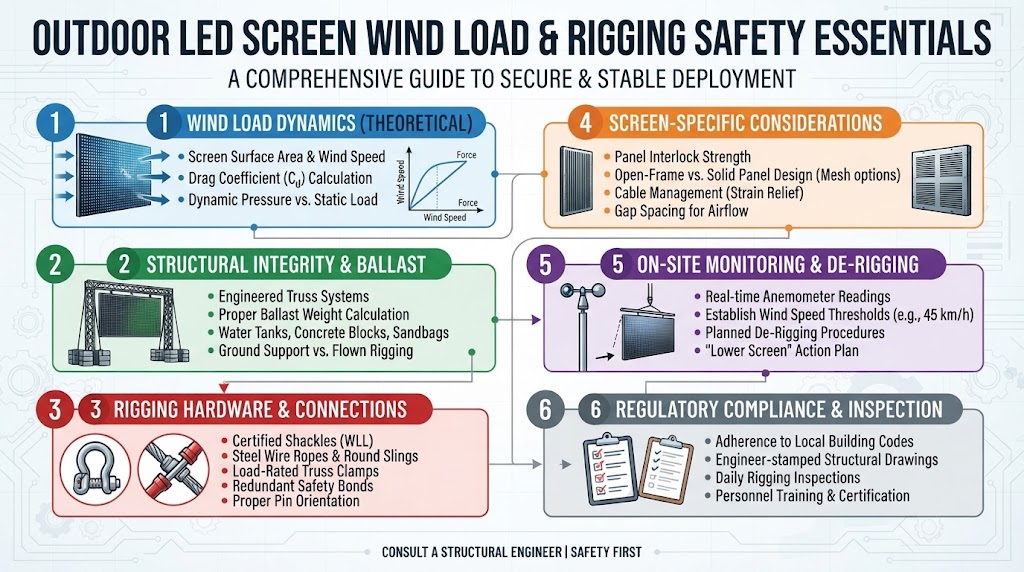
Step 1: FEA (Finite Element Analysis): We perform structural stress tests on all custom frames to simulate wind loads and vibration, particularly for Digital Out-of-Home (DOOH) installations.
Step 2: CNC-Driven Module Customization: Using our in-house CNC workshop, we produce frames that match the exact CAD drawings of the client's space, ensuring a perfect fit.
Step 3: Thermal Dissipation Simulation: We model heat flow to ensure the display maintains LEED compliance and longevity, even when integrated into Smart Glass Technology environments.
This framework allows us to deliver Transparent LED Screen Series products that are as durable as they are visually stunning.
Geometric Versatility: Cylindrical, Triangular, and Hexagonal Modules
Standard displays are limited by their 16:9 or 4:3 ratios. However, experiential design often requires cylindrical transparent LED displays or irregular polygons like triangles and hexagons. These shapes are essential for wrapping around structural pillars or creating immersive digital signage in retail flagship stores.
Our flexible LED mesh solutions are particularly effective for non-linear architectural surfaces. By decoupling the LEDs from a rigid frame, we can follow the contours of a building's "skin," creating a media architecture effect where the building itself becomes the screen. This is frequently used in Augmented Reality Integration projects where the physical and digital worlds overlap.
Performance Metrics: Transparency vs. Resolution Trade-offs
Selecting the right custom display requires balancing the transparency rate with the required high brightness nits. Higher resolution (smaller pixel pitch) typically results in lower transparency because the LED density is higher.
| Pixel Pitch (mm) | Transparency (%) | Brightness (nits) | Best Use Case |
|---|---|---|---|
| P2.6 - P5.2 | 65% - 70% | 1,200 - 4,500 | Indoor Retail / Close Viewing |
| P3.9 - P7.8 | 75% - 80% | 3,500 - 5,500 | Architectural Facades |
| P10.4 | 82% + | 5,000 - 7,000 | Large Scale Outdoor / DOOH |
For more technical details on how these metrics affect your project, explore our Indoor LED Display Solutions for high-resolution interior applications.
In-House CNC Manufacturing: From Design Brief to Installation
Guanhong Display maintains a dedicated CNC workshop specifically for custom frame manufacturing. This facility allows us to bypass the limitations of mass-produced hardware. When a designer submits a brief for an irregular shape—such as a wave-patterned ceiling or a triangular corner—we mill the aluminum alloy frames to a 0.05mm precision level.
This factory direct LED advantage ensures that structural safety is never compromised. Our custom frames are designed with integrated cable management and cabinet-free design principles where possible, reducing the overall weight on the glass facade. You can see examples of these complex installations in our LED Display Case Studies.
Frequently Asked Questions about Custom Transparent LEDs
How do you maintain a curved transparent LED screen?
We design custom screens with front-access maintenance. Individual LED strips or modules can be replaced without dismantling the entire structural frame, minimizing downtime in commercial spaces.
Can custom shapes handle 3D anamorphic content?
Yes. By precisely mapping the control systems to the physical geometry of the screen, we can create 3D "naked eye" effects on curved or corner-wrapped transparent displays.
Is the power consumption higher for custom displays?
Power consumption is primarily driven by brightness and pixel density. However, our use of energy-efficient SMD technology and intelligent light sensors ensures that the display only uses the power necessary for current ambient conditions.
Ready to Engineer Your Vision?
Contact Guanhong Display today to consult with our lead engineers on your custom project. We provide full FEA reports and CAD designs to bring your experiential space to life.
Submit Your Design Brief for a Custom SolutionReferences:
1. Institute of Electrical and Electronics Engineers (IEEE) - Standards for Optoelectronics
2. The American Institute of Architects (AIA) - Digital Integration in Architecture