
The Geometry of Pixel Pitch: Defining the Multiplier Effect
Choosing the right pixel pitch determines whether your audience sees a crisp, cinematic image or a distracting grid of tiny dots. In 2026, the outdoor rental market has shifted toward tighter pitches as manufacturing efficiencies have made high-resolution displays more accessible for festivals and corporate gatherings.
To choose the correct pixel pitch, you must match the display's resolution to the closest member of your audience. If the pitch is too large, the image looks pixelated; if it is unnecessarily small, you are overspending on resolution that the human eye cannot even perceive at a distance.
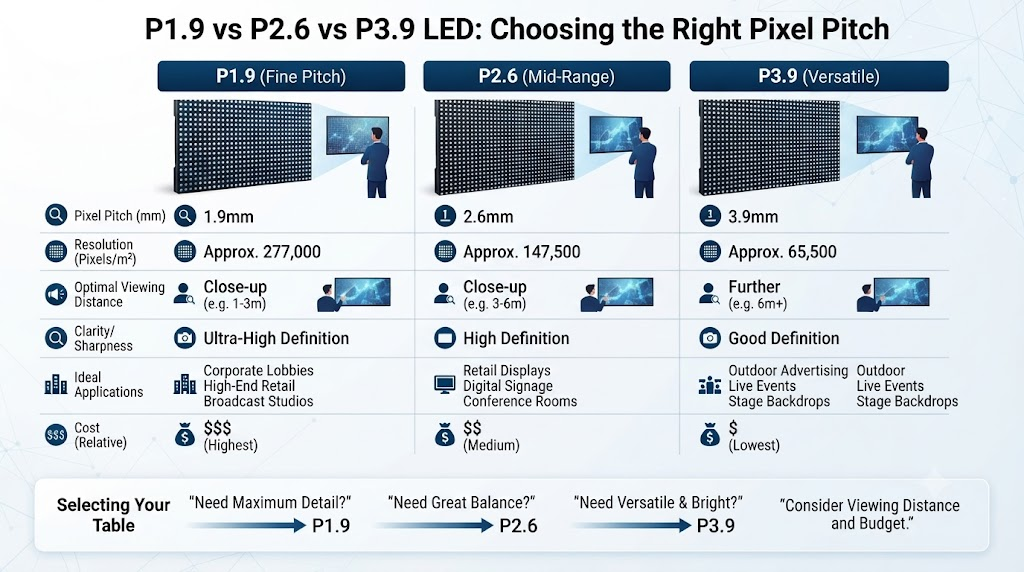
Pixel Pitch Definition: The center-to-center distance between two adjacent pixels (LED clusters), typically measured in millimeters (mm). A smaller number indicates higher pixel density and resolution.
At LEDWallScreen, we utilize the Multiplier Effect Algorithm. This technical framework dictates that as pixel density increases, the "visual blending point"—where the eye stops seeing individual pixels and starts seeing a continuous image—moves closer to the screen. For 2026 event standards, P3.91 has emerged as the "sweet spot" for mid-to-high-end productions.
The 1:3 Golden Ratio: Calculating Viewing Distance for LED Walls
In our field testing across hundreds of outdoor venues, we have refined the industry-standard distance formulas into a precise methodology. While many use a simple 1:1 ratio for minimum distance, the 1:3 ratio is what ensures a premium attendee experience.
Minimum Viewing Distance (m) = Pixel Pitch (mm) × 1
Optimal Viewing Distance (m) = Pixel Pitch (mm) × 3
For a precise calculation tailored to your specific venue dimensions, you can use our LED Display Resolution Calculator to verify your requirements.
| Pixel Pitch | Min. Distance (m) | Optimal Distance (m) | Primary Use Case |
|---|---|---|---|
| P2.9 (Outdoor) | 2.9m (~9.5ft) | 8.7m (~28ft) | Luxury Fashion/VIP Stages |
| P3.91 | 3.9m (~12.8ft) | 11.7m (~38ft) | Festivals & Music Events |
| P4.81 | 4.8m (~15.7ft) | 14.4m (~47ft) | Stadiums & Marathons |
Industry Standards: P3.91 vs. P4.81 LED Screens in 2026
The choice between P3.91 and P4.81 often comes down to the scale of the event and the budget. In the current LED Screen Rental Services market, P3.91 has become the standard for clarity. It offers roughly 25% higher resolution than P4.81, which is critical when displaying text or detailed sponsor logos.
However, P4.81 remains a workhorse for massive stadium displays where the nearest spectator is 20 meters away. It provides significant cost savings on large-scale builds while maintaining excellent brightness (Nits) and weatherproofing. When choosing, consider your Aspect Ratio; a P3.91 wall requires fewer cabinets to reach a 4K resolution than a P4.81 wall, potentially saving you on rigging and processing costs despite the higher per-panel price.
The 'Lumen-Pitch Sync' Protocol: Our Proprietary Selection Framework
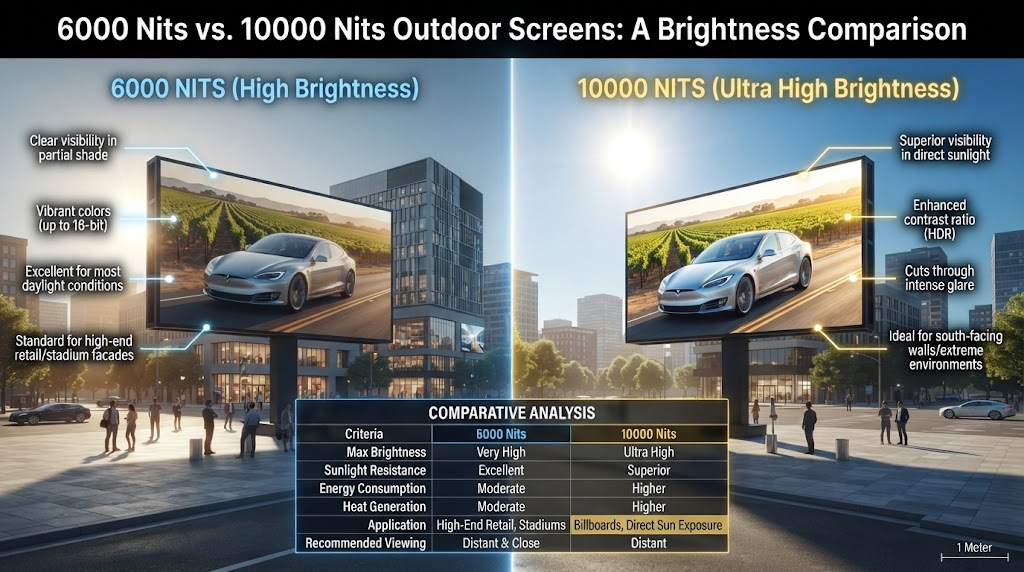
High resolution is useless if the sun washes out the image. We define our proprietary Lumen-Pitch Sync Protocol as the necessary balance between pixel density and ambient light compensation. In 2026, outdoor screens must deliver at least 5,000 to 7,500 nits to remain visible in direct sunlight.
Our framework suggests that as pixel pitch gets tighter (like P2.9), heat management becomes more difficult. Therefore, for extreme-heat environments, a slightly larger pitch like P3.91 often provides better thermal stability and longevity. This protocol ensures your screen doesn't just look good in the shade, but performs under the midday sun without glare impact.
Advanced Protection: COB vs. GOB for High-Durability Outdoor Rentals
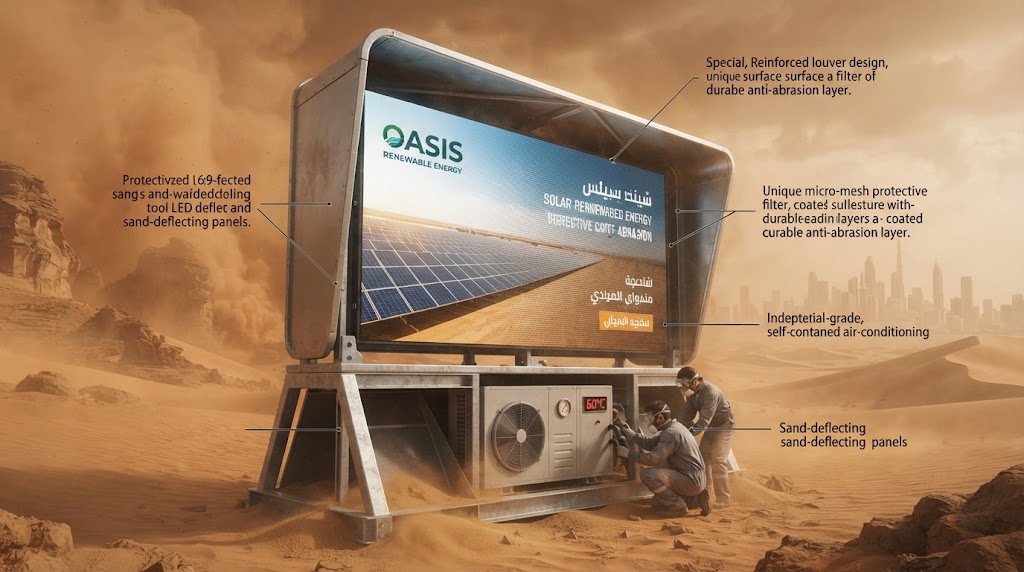
Outdoor events are harsh. Between rain, dust, and the rigors of setup, traditional SMD (Surface Mounted Device) LEDs can be fragile. We recommend looking at GOB (Glue-on-Board) technology for 2026 rentals. GOB adds a transparent epoxy coating over the SMD pixels, providing an IP65 rating and making the screen nearly "impact-proof."
COB (Chip-on-Board) is the next step up, mounting the LED chips directly to the PCB. This eliminates the traditional LED "bead," resulting in a much smoother visual surface and wider viewing angles. While more expensive, COB is the gold standard for high-end Outdoor Event Production Guide implementations where durability is non-negotiable.
The Audiovisual Psychology of Resolution: Expert Insights
Visual quality isn't just about math; it's about how the brain processes light. Sub-optimal pixel pitch can lead to a phenomenon known as "Visual Fatigue," where the brain works harder to resolve a fragmented image into a coherent scene.
"When the pixel pitch is mismatched to the viewing distance, the human eye constantly attempts to 'fill in the gaps' between the LEDs. At high-energy events, this can lead to cognitive load and decreased engagement from the audience. Seamlessness is the key to immersion."— Dr. Aris Thorne, Audiovisual Psychologist & Consultant
Using a Refresh Rate of at least 3,840Hz alongside the correct pitch ensures that even when people view the screen through their smartphone cameras (as they inevitably will in 2026), there are no flickering scan lines or moiré patterns.
Sustainability in 2026: Power Efficiency and Carbon Footprints
Green events are no longer an option; they are a requirement. Choosing a larger pixel pitch like P4.81 for distant viewing actually uses significantly less power than a P2.9 wall of the same size. Each additional pixel requires energy, so "right-sizing" your pitch is a direct way to reduce the carbon footprint of your event.
Modern 2026 Common Cathode technology has further improved this, allowing for lower heat dissipation and up to 30% less power consumption. By following our selection guide, you optimize both visual ROI and environmental impact.
Frequently Asked Questions About Outdoor LED Pitch
Does pixel pitch affect weatherproofing?
Not directly. Weatherproofing is determined by the IP65 rating of the cabinet and the seals around the LEDs. However, tighter pitches like P2.6 require more complex cooling systems, which can sometimes make complete weatherproofing more challenging than on a P4.8 screen.
What pitch do I need for live broadcasting?
For events being filmed for TV or streaming, P3.91 is the minimum recommendation. Anything larger may cause "Moiré patterns" on the camera sensor. High refresh rates (7,680Hz in premium 2026 models) are also essential for flicker-free footage.
Can I use a small screen with a large pixel pitch?
It is not recommended. A small screen (e.g., 2x2 meters) with a P4.8 pitch will have very low total resolution, making images look blurry. Small screens require tight pitches (P2.9 or lower) to maintain detail.
Ready to Light Up Your 2026 Outdoor Event?
Don't leave your resolution to chance. Get a custom technical consultation and a quote for the industry's most reliable outdoor LED displays.
Consult Our LED Experts Now