
Understanding Pixel Pitch: The Foundation of LED Clarity
Pixel pitch is the physical distance from the center of one LED cluster (pixel) to the center of the next. For any Indoor LED Display Solutions, this measurement determines the minimum viewing distance and the total resolution of the wall.
At Guanhong Display, we utilize advanced SMD technology (Surface Mounted Device) to ensure each diode is perfectly aligned. A smaller pitch means more pixels are packed into the same surface area, resulting in higher detail but increased manufacturing complexity. As a premier LED display manufacturer, we focus on the precision of these center-to-center measurements to eliminate visual gaps.
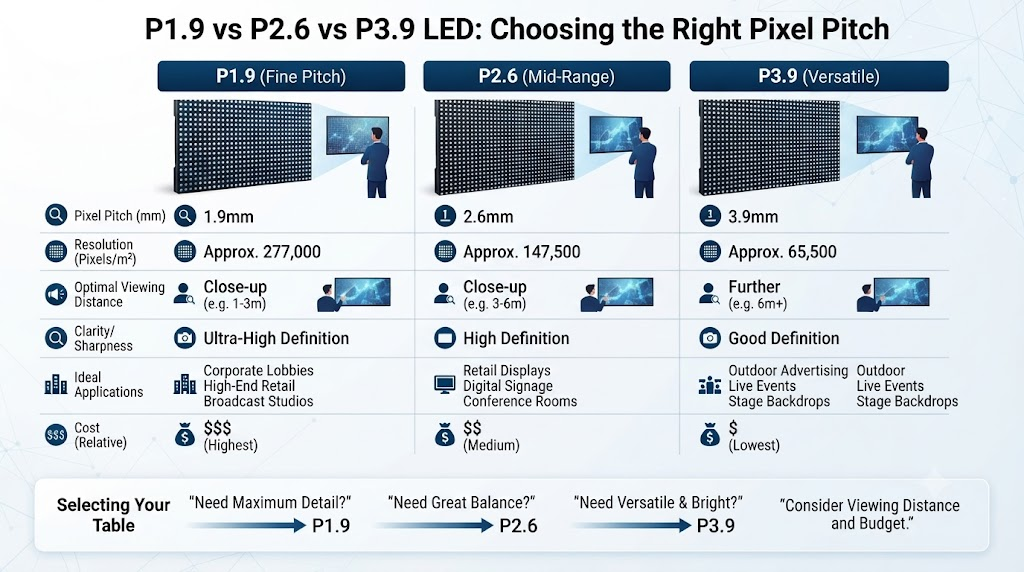
P1.9 vs P2.6 vs P3.9
To choose correctly, evaluate the closest point where your audience will stand. P1.9 is best for distances under 2 meters (6.5 ft), P2.6 is the versatile choice for 2.6 to 4 meters, and P3.9 is ideal for large-scale events where viewers are at least 4 meters (13 ft) away. For most modern indoor rentals, P2.6 provides the optimal balance of high-definition performance and rental durability.
| Feature | P1.9 | P2.6 | P3.9 |
|---|---|---|---|
| Pixel Density (dots/sqm) | 277,008 | 147,456 | 65,536 |
| Optimal Min. Distance | 1.9 Meters | 2.6 Meters | 3.9 Meters |
| Primary Application | Broadcast/Boardroom | High-end Rental | Large Stage/Concert |
The Science of Resolution: Pixel Density and Retina Clarity
In 2026, the concept of Retina Resolution in LED displays has become the benchmark for quality. This refers to the point where the human eye can no longer distinguish individual pixels, creating a continuous, lifelike image. This is mathematically tied to the Pixels per Square Meter.
"The difference between a P1.9 and a P2.6 isn't just resolution; it's the mathematical alignment of light emission and human optical perception," says Dr. Zhang, Lead Optical Engineer at Guanhong Display.
A P1.9 display offers nearly 4.2 times the pixel density of a P3.9. When viewers are close, such as in a corporate lobby or a TV studio, this density prevents "pixelation." For larger Fine Pitch LED Walls, achieving this clarity is essential for professional Visual Resolution.
The Guanhong Visual Threshold Protocol
To simplify selection for our clients, we developed The Guanhong Visual Threshold Protocol. This methodology utilizes the "1:1 Rule" combined with AVIXA DISCAS standards to ensure perfect viewing experiences.
Step 1: Metric Alignment. The pitch value in millimeters equals the minimum viewing distance in meters (e.g., P2.6 = 2.6m).
Step 2: Content Analysis. High-detail text requires 20% closer pitch than video-only content.
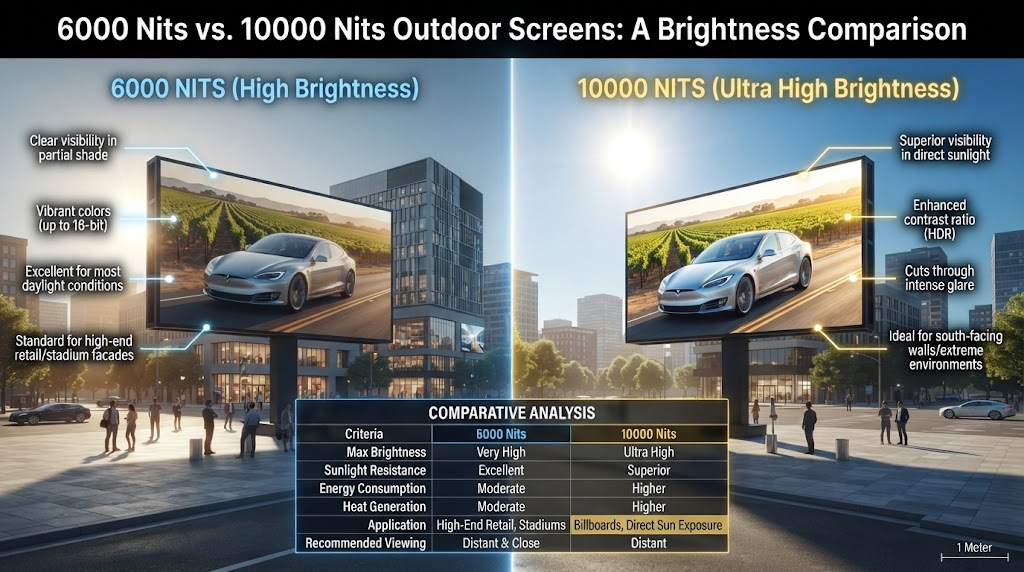
Step 3: Ambient Light Adjustment. Higher brightness (nits) can sometimes compensate for slightly larger pitch by increasing perceived contrast.
By following this protocol, you avoid overspending on a P1.9 when a Rental LED Screen Inventory of P2.6 would provide the same perceived quality at a lower cost.
Technical Specifications: Refresh Rates and IC Driver Performance
Pixel pitch doesn't work in a vacuum. For broadcast quality LED, the refresh rate is paramount. At Guanhong, our P1.9 and P2.6 panels typically feature 7680Hz refresh rates and high-end IC Drivers to eliminate the moiré effect during filming.
When using a Novastar control system, these screens maintain exceptional grayscale performance even at low brightness. This is critical for indoor environments where high-nit brightness (above 1000 nits) might be too intense for the audience, but color accuracy must remain perfect.
Application Scenarios: Choosing the Right Pitch for Your Event
Different events demand different pixel densities. Based on our 2026 data, here is how the industry categorizes these solutions:
P1.9: The Corporate Elite
Best for corporate event AV, boardrooms, and command centers. If your audience is sitting within 5-10 feet of the screen, P1.9 is mandatory for seamless splicing of data-heavy charts and 4K video.
P2.6: The Trade Show Workhorse
The go-to for a trade show LED display. It offers enough resolution for stunning brand visuals while being robust enough for frequent assembly and disassembly in die-cast aluminum cabinets.
P3.9: The Concert Standard
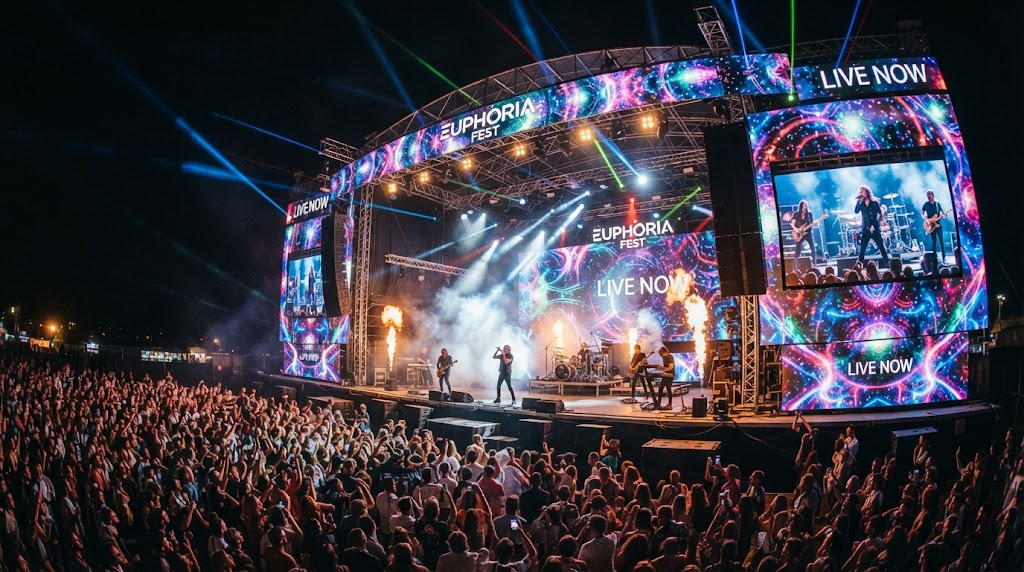
Ideal for concert stage backdrops. When the audience is 15+ feet away, the cost savings of P3.9 allow for much larger screen surfaces without sacrificing the visual impact of the performance.
ROI and Budgeting: Balancing Performance and Cost
Budgeting for an LED wall involves more than the initial price. A P1.9 screen has higher maintenance costs due to the fragility of small pixels and the higher number of spare parts required.
However, the rental inventory ROI for P2.6 is currently the highest in the market. Its versatility across various event types ensures high utilization rates. When calculating ROI, consider the power consumption per sqm; P1.9 typically draws more power due to the sheer number of LEDs per cabinet.
Frequently Asked Questions About LED Pixel Pitch
Can I use P3.9 for a small conference room?
It is not recommended. At close distances, viewers will see the "screen door effect," where individual LEDs are visible, making text difficult to read.
What is the cabinet weight difference?
Most Guanhong 500x500mm rental LED cabinets weigh between 7kg and 8kg, regardless of pitch, thanks to our lightweight magnesium alloy frames.
Is P1.9 difficult to maintain?
P1.9 requires professional LED maintenance. We provide vacuum suction tools for front-service access to ensure modules are handled without damaging the fine-pitch diodes.
Ready to Transform Your Venue?
Get a professional consultation and a free quote on our P1.9, P2.6, and P3.9 LED solutions tailored to your specific needs.
Request a Custom Quote Now