
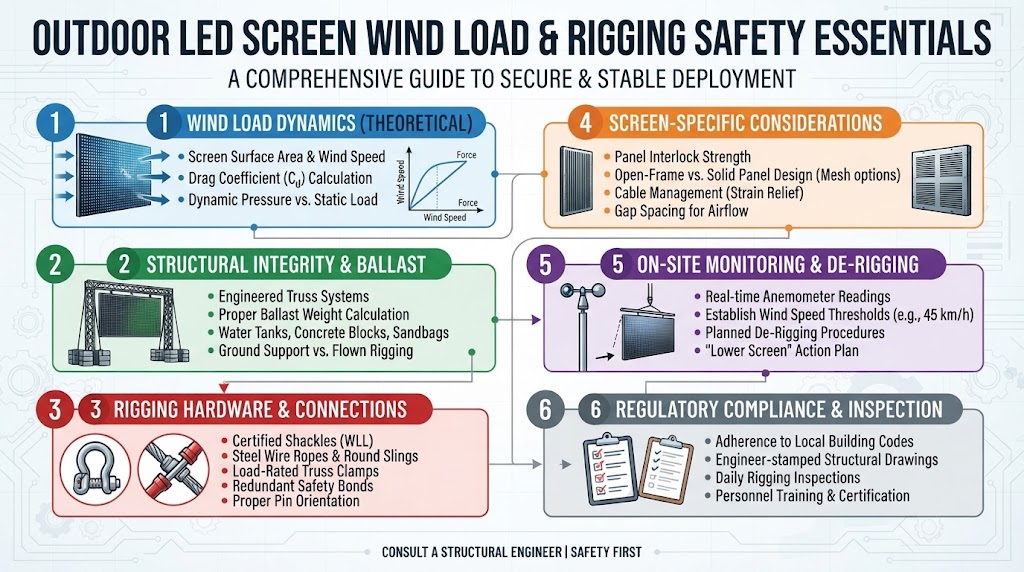
Outdoor LED Screen Wind Load & Rigging Safety Essentials
Calculating outdoor LED screen wind load requires combining dynamic wind pressure calculations (P = 0.613 × V²) with structural dead weight to determine lateral shear, overturning moments, and hoist safety factors under standards like ANSI/ESTA E1.21. Solid die-cast panels convert nearly 100% of frontal wind energy into horizontal kinetic force on trusses, demanding engineered ground-support ballast or certified overhead rigging points capable of absorbing multi-ton dynamic live loads.
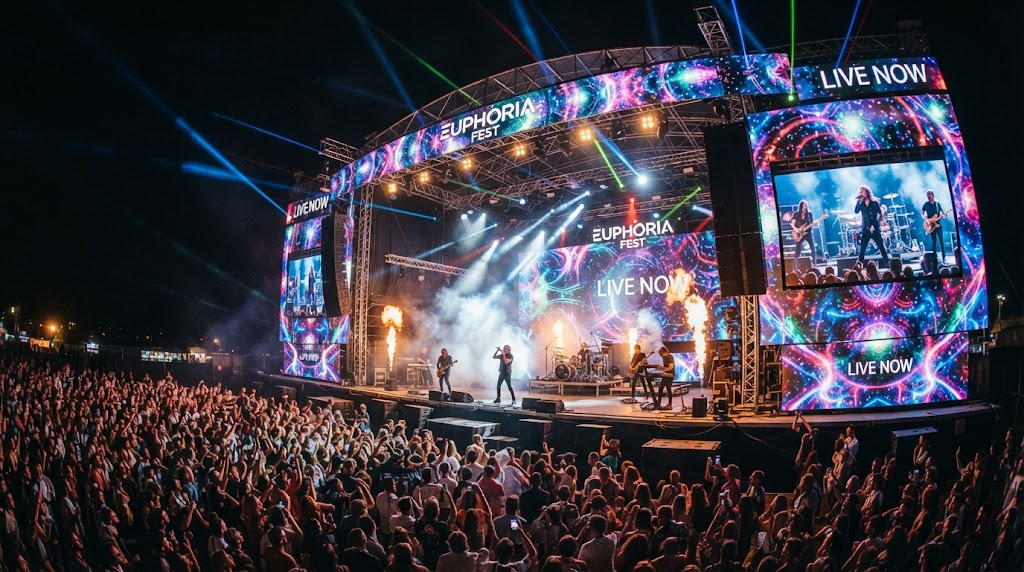
Temporary outdoor stage walls transform lightweight LED modules into vertical sails. Safe deployment relies on precise aerodynamic force coefficients, rigid mechanical locking, structural load modeling, and active wind-speed monitoring.
"Structural failure in outdoor staging is rarely caused by dead weight alone. Catastrophic collapses occur when dynamic gust energies exceed the horizontal shear limits of truss clamps or overturn unballasted base towers."
— Marcus Vance, PE, Principal Structural Rigging Specialist at Guanhong Display Technical Labs
Aerodynamic Physics: Calculating Dynamic Wind Load on LED Video Walls
Determining the physical forces acting on an outdoor video wall begins with fluid dynamics. The standard formula for dynamic velocity pressure (qz) derived from Bernoulli's principle is:
Where:
P (or qz): Dynamic wind pressure measured in Pascals (N/m²).
V: Wind velocity in meters per second (m/s).
0.613: Ambient air density constant under standard atmospheric conditions (1.225 kg/m³ at sea level / 2).
When wind hits 20 m/s (approx. 45 mph or Force 8 on the Beaufort Scale), the dynamic pressure generated against a flat surface is:
To determine the total lateral wind force (Fw) transferred to the rigging structure, apply the aerodynamic drag formula:
Where A represents screen surface area (m²), Cd is the drag coefficient (typically 1.2 to 1.4 for flat, solid rectangular plates), and G is the gust response factor (standard 1.15 to 1.30 per ASCE 7-22 / Eurocode 1 guidelines).
Height Exposure and Boundary Layer Aerodynamics
Wind speed increases with height above ground level. A festival stage screen suspended at a trim height of 12 meters experiences significantly higher dynamic pressure than a screen standing on a 1-meter deck.
Structural modeling per Eurocode 1 (EN 1991-1-4) accounts for terrain roughness, topographic wind acceleration, and vertical wind shear profiles. Rigging engineers must calculate wind loading at the top edge of the video wall to prevent localized truss deflection.
Solid Aluminum Cabinets vs. Transparent LED Mesh: Porosity vs. Drag Realities
A common misconception among stage designers is that a transparent LED mesh screen with a 40% optical transparency rating cuts total wind load by 40%. Fluid dynamics and wind-tunnel testing reveal a different result.
Optical Openness vs. Aerodynamic Porosity
While light passes straight through transparent LED modules, air molecules must navigate structural obstacles. Internal PCB bar depth, die-cast framing ribs, waterproof potting compound, and optical louvers create micro-turbulence and boundary-layer blockages.
Guanhong Display laboratory testing confirms that an outdoor screen with 40% visual transparency delivers an effective aerodynamic permeability of only 20% to 28% when air strikes at an incident angle between 0° and 45°.
| Cabinet Architecture | Optical Transparency | Aerodynamic Drag (Cd) | Lateral Wind Force (kN) | Overturning Moment (kN·m) |
|---|---|---|---|---|
| Standard Solid Die-Cast Aluminum | 0% | 1.30 | 19.1 kN | 57.3 kN·m |
| Guanhong Lightweight Mesh (P3.9-7.8) | 35% | 0.95 | 13.9 kN (-27%) | 41.7 kN·m |
| Guanhong High-Permeability Touring Curtain | 55% | 0.75 | 11.0 kN (-42%) | 33.0 kN·m |
Using transparent mesh substantially lowers lateral shear forces on mother grids and ground towers. However, conservative engineering models must never assume zero wind resistance on open-mesh walls.
Global Rigging Standards & Certification Frameworks: ANSI E1.21 & TÜV Rheinland
Temporary outdoor LED video installations must adhere to strict international engineering guidelines to safeguard public safety and prevent liability.
Key International Regulatory Codes
ANSI/ESTA E1.21: The benchmark standard in North America for temporary outdoor stage structures. It dictates structural stability, dynamic gust management, operational wind action protocols, and designated wind reduction measures.
TÜV Rheinland Structural Certification: Rigorous German technical safety verification governing structural calculations, weld integrity, alloy yield strength, and payload limits under temporary dynamic configurations.
EN 13814: European standard regulating fairground and amusement park structures, widely applied to temporary outdoor concert rigging and large-scale video display arches.
Eurocode 9 (EN 1999) & Eurocode 1 (EN 1991-1-4): Standards governing aluminum structural design and environmental wind actions across member states.
Rigging Safety Factors: Dead Load vs. Live Aerodynamic Forces
Under stationary indoor conditions, standard rigging hardware operates on a minimum 5:1 safety design factor (or 8:1 / 10:1 for specific European D8+ / BGV-C1 overhead hoist standards). In outdoor environments, dynamic wind loading converts static dead loads into complex multi-axis stresses.
Overhead rigging clamps, quick-release pins, and spreader beams must maintain a minimum 8:1 to 10:1 working load limit (WLL) to withstand dynamic peak gusts without structural metal fatigue or clamp shear deformation.
Truss Weight Capacities & Chain Hoist Load Distribution (500kg vs. 1000kg Hoists)
Correctly calculating point loads along aluminum box trussing requires analyzing dead weight, cable infrastructure, wind-induced uplift, and horizontal torque.
500 kg vs. 1000 kg Electric Chain Hoist Allocation
Selecting the right motor capacity is not just about holding the static weight of the screen panels. Consider a 10m × 5m outdoor screen weighing 1,500 kg (30 kg/m² dead weight):
Static Weight: 15 kN (1,500 kg) distributed over 5 pick points = 300 kg static dead load per hoist.
500 kg Hoists: With only 200 kg of reserve capacity per hoist, a sudden 18 m/s wind gust can exceed motor brake limits due to vertical load transfer from bridle angles and overturning torque.
1000 kg Hoists: Using 1-ton (1000 kg) D8+ chain hoists provides an essential safety margin, absorbing high-wind uplift, dynamic snatch forces, and asymmetric load shedding without overloading the motor brake.
Bridle Angle Geometry & Tension Multipliers
Riggers must minimize wide bridle angles. As the internal angle of a suspension bridle widens, tension on each leg increases rapidly:
At 60°: Leg tension equals 58% of the total load per leg.
At 90°: Leg tension rises to 71% of the total load.
At 120°: Leg tension spikes to 100% of the total suspended weight on each individual leg.
When high winds push the screen horizontally, these tension multipliers multiply the risk of truss deflection and mechanical hardware failure.
The Guanhong AeroRig™ 4-Vector Structural Safety Protocol
To eliminate rigging guesswork for touring productions and outdoor installations, Guanhong Display engineers developed the AeroRig™ 4-Vector Protocol. This systematic framework ensures structural integrity from design to teardown.
Vector 1: Aerodynamic Profiling & Module Selection
Analyze local wind history for the venue. If historical gust data exceeds 15 m/s, specify high-permeability mesh cabinets (such as Guanhong's Outdoor Touring Mesh Series) over solid die-cast panels to lower base drag by up to 35%.
Vector 2: Static & Dynamic Load Path Balancing
Calculate total dead weight, cable loom loads, and dynamic peak gust forces across all support trusses. Distribute pickup points to avoid eccentric loads on corner joints and preserve truss deflection limits within L/300 spans.
Vector 3: Counterweight & Ground Support Ballast Matrix
For ground-supported LED video walls, overturning moments must be counteracted by solid concrete or water-tank ballasts. Calculate counterweight requirements with this stability formula:
Ballast must sit on non-slip, load-spreading mats. Steel guy-wires tensioned with calibrated load cells should anchor the top corners back to ground stakes rated for local soil conditions.
Vector 4: Automated Anemometer & Telemetry Monitoring
Mount a calibrated ultrasonic or cup anemometer directly to the highest point of the LED truss structure. Connect telemetry data to the front-of-house (FOH) control console to provide production managers with real-time wind speed tracking and threshold alerts.
Operational Wind Action Plans (WAP) & Emergency De-Rigging Protocols
Every outdoor temporary structure requires a site-specific Wind Action Plan (WAP) per ANSI E1.21. Production teams must establish clear, non-negotiable operational thresholds:
| Alert Level | Wind Velocity | Status Description | Mandatory On-Site Actions |
|---|---|---|---|
| GREEN (Normal) | 0 – 11 m/s (0 – 25 mph) | Safe Operating Conditions | Continuous telemetry monitoring; standard display operation. |
| YELLOW (Pre-Alert) | 12 – 14 m/s (27 – 31 mph) | Elevated Wind Gust Activity | Alert structural lead and safety officer; inspect ballast anchor lines. |
| ORANGE (Preparation) | 15 – 19 m/s (34 – 43 mph) | Critical Threshold Approaching | Clear perimeter below wall; prepare motors; pause high-altitude maintenance. |
| RED (Evacuation/Lower) | ≥ 20 m/s (≥ 45 mph) | Exceeds Safety Threshold | Immediately lower LED screen to ground/trim position; secure with storm straps. |
Safe Emergency De-Rigging Procedures
Lowering a wide LED video wall in high winds can be dangerous. As the screen descends, lower boundary layers can create turbulent buffeting.
Rigging teams must lower the screen smoothly and evenly using synchronized motor control systems. Once the wall reaches its lowest mechanical trim height, lock it to ground ballast frames using heavy-duty ratchet tie-downs to prevent horizontal sway.
Engineering Support: Request Custom 100m² LED Wind Rigging CAD Drawings
Deploying large-format outdoor LED walls requires careful structural calculations and site-specific engineering. Guanhong Display designs, manufactures, and verifies high-durability outdoor rental displays, wind-shedding mesh systems, and ultra-lightweight magnesium alloy touring cabinets built to handle demanding weather conditions.
Our in-house structural engineering team collaborates directly with technical directors, production managers, and AV rental houses worldwide to supply stamped structural calculations and certified CAD rigging layouts.
Need Certified Wind Calculations for Your Upcoming Event?
Contact our engineering department to receive a custom 100m² LED wind load calculation package, complete with truss point-load tables, ballast specifications, and PE-stamped CAD rigging drawings.
Request Rigging CAD Drawings & Engineering SupportFrequently Asked Questions: Outdoor LED Screen Wind Load & Rigging
What is the primary formula used to calculate wind load pressure on an LED wall?
Dynamic wind velocity pressure is calculated using P = 0.613 × V² (in metric units), where P is pressure in N/m² and V is wind speed in meters per second. Total lateral force is then determined by multiplying dynamic pressure by screen area, the drag coefficient (Cd), and the gust response factor.
Does a 50% transparent LED screen reduce wind resistance by half?
No. While 50% optical transparency lets half the light through, structural elements like horizontal shaders, frame edges, and internal PCBs create boundary-layer drag. Aerodynamic resistance drops by only 25% to 35% compared to a solid screen, depending on the panel's depth and angle of incidence.
How do you choose between 500 kg and 1000 kg hoists for outdoor LED displays?
Engineers calculate total static weight along with dynamic live load factors. If horizontal wind loads or wide bridle angles transfer dynamic peak forces exceeding 60% of a 500 kg hoist's working limit, 1000 kg (1-ton) chain hoists are required to maintain a certified 8:1 or 10:1 safety factor.
What is the maximum safe wind speed for operating outdoor LED video screens?
Under ANSI/ESTA E1.21 guidelines, most temporary outdoor LED walls are rated for full operation up to 12–15 m/s (approx. 27–34 mph). When sustained gusts reach 15–20 m/s (34–45 mph), operators must lower the screen to ground level and secure all storm anchors.