
High-Temp IP68 Outdoor LED Displays for 60°C Climates
Engineering Outdoor LED Displays for Extreme 60°C Climates and Desert Sandstorms
Operating a high-brightness Outdoor LED Display Solutions deployment in ambient temperatures exceeding 50°C—where direct solar radiation pushes internal surface temperatures above 75°C—requires eliminating standard mechanical failure points. Surviving these conditions demands fanless, passive heat dissipation through precision die-cast aluminum chassis, energy-efficient common cathode drive circuitry, and hermetically sealed IP68 module construction with internal thermal decoupling.
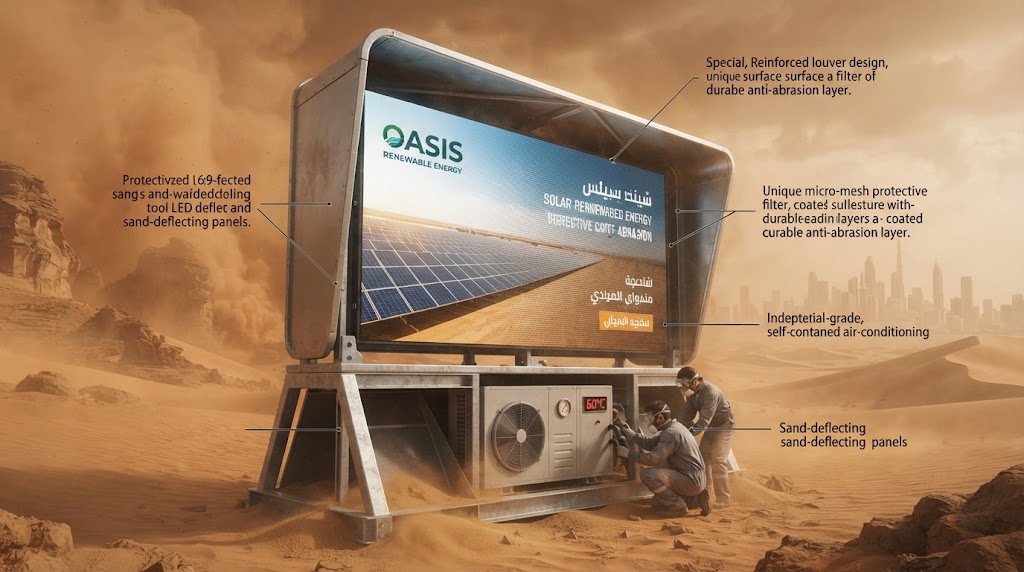
In regions such as the Gulf Cooperation Council (GCC), North Africa, and the Southwestern United States, outdoor digital signage faces a dual threat: blistering solar loading and aggressive silica dust storms. Standard commercial screens experience rapid color degradation, power supply burnout, and catastrophic moisture/dust ingress within 12 to 18 months.
Engineering direct-view LED (dvLED) displays for these environments requires balancing semiconductor junction temperatures, structural thermal conductivity, and micro-particle hermetic barriers.
The Physics of Thermal Degradation: Junction Temperature ($T_j$) and L70 Decay
The operational lifespan of a Surface-Mount Device (SMD) LED is fundamentally governed by its internal semiconductor junction temperature ($T_j$). As junction temperature climbs past nominal limits, optical output drops exponentially, and degradation accelerates.
The mathematical relationship governing junction temperature is expressed as:
T_j = T_a + (R_{th(j-a)} × P_d)
Where $T_a$ is ambient temperature, $R_{th(j-a)}$ is the thermal resistance from junction to ambient (°C/W), and $P_d$ is total power dissipation. When outdoor ambient temperatures hit 55°C and solar irradiance adds another 15°C–20°C of thermal loading, unoptimized displays push $T_j$ beyond 95°C.
Under these conditions, standard epoxy encapsulants turn yellow, phosphor binders degrade, and the LED chip experiences rapid luminous flux depreciation, drastically shortening the time to L70 (the duration until brightness drops to 70% of its initial value).
"Operating an LED diode with a junction temperature above 85°C cuts its usable operational life in half for every 10°C rise. Without dedicated chassis-level conductive paths, high-brightness displays will suffer noticeable wavelength drift and color shifts within their first summer."
— Chief Thermal Architect, Guanhong Display
Wavelength Drift and Forward Voltage Decay
Excessive thermal buildup alters the bandgap energy of LED dies (InGaN for blue/green and AlInGaP for red). This shift causes visible color shifts across the display wall:
Red LEDs: Peak wavelength shifts upward by approximately 0.1 nm/°C, causing deep reds to shift toward orange-red.
Forward Voltage ($V_f$) Drop: Forward voltage declines at roughly -2 mV/°C, destabilizing current balance across passive matrix configurations.
Luminance Imbalance: Uneven heat across the panel creates thermal hot spots, producing visible blotching on solid white screens.
Advanced Heat Dissipation: Fanless Die-Cast Aluminum vs. Active HVAC Forced Air
Traditional outdoor engineering often relied on forced-air ventilation or auxiliary air conditioning (HVAC) systems. In arid, sand-heavy environments, active cooling systems introduce severe points of failure.
Air filters clog with airborne particulate matter within days, causing fans to stall and compressors to burn out. This leads to immediate thermal shutdown of the entire display.
Modern high-reliability Commercial DOOH LED Billboards use passive heat dissipation through die-cast aluminum enclosures. Aluminum alloy exhibits superior thermal conductivity compared to stamped iron cabinets or polymer composites.
| Material / Design | Thermal Conductivity ($W/m\cdot K$) | Failure Vulnerability | Maintenance Overhead |
|---|---|---|---|
| Guanhong Die-Cast Aluminum (ADC12) | 120 – 160 | Zero (Solid-state passive convection) | Zero routine mechanical maintenance |
| Standard Stamped Iron Cabinet | 40 – 50 | Moderate (Internal heat traps) | Medium (Corrosion & paint degradation) |
| Plastic / Polycarbonate Chassis | 0.19 – 0.25 | Extreme (Acts as a thermal insulator) | High (Structural warpage under UV) |
| Active HVAC / Fan-Ventilated Cabinets | N/A (Air-driven) | Catastrophic (Sand clogging, fan seizure) | High (Bi-weekly filter cleaning/replacement) |
By eliminating fans, the cabinet remains fully enclosed. This removes air exchange pathways and prevents fine silica dust from entering the housing, eliminating internal abrasive damage and short circuits.
The Dual-Cavity Architecture & Common Cathode Power Distribution
Effective thermal management relies on two key technologies: isolated dual-cavity structural design and Common Cathode driver distribution.
Chamber A: Isolated Switched-Mode Power Supply (SMPS) & Receiving Card | Chamber B: Hermetically Sealed High-Efficiency LED Matrix Backplane.
Dual-Cavity Physical Decoupling
In standard LED designs, heat from power supplies radiates directly onto the display module PCB. Guanhong Display's dual-cavity architecture physically separates the power supply unit (PSU) and signal receiving cards into an isolated rear structural bay.
Thermally conductive gap pads route heat from high-wattage components straight into the outer aluminum fins. This setup isolates the LED diodes from the power supply's heat, keeping module backplanes significantly cooler.
Common Cathode vs. Common Anode Heat Generation
Standard displays use Common Anode architecture, supplying a uniform 5.0V or 4.2V rail to Red, Green, and Blue diodes alike. However, Red diodes only require approximately 2.1V to 2.4V to operate. The excess voltage is burned off as pure waste heat across driver ICs.
Common Cathode architecture solves this by providing split power rails: 2.8V dedicated to Red diodes and 3.8V dedicated to Blue and Green diodes. This precise voltage matching cuts overall display power draw by up to 35% and eliminates internal heat generation at the source.
FLIR Thermal Video: Common Cathode (38.2°C surface) vs Common Anode (53.7°C surface) at 55°C Ambient Testing.
Thermal chamber tests verify that at a 55°C ambient temperature under full 10,000-nit white balance load, common cathode architecture paired with an all-aluminum chassis reduces surface temperatures by 12°C to 15°C compared to conventional cabinets. This keeps long-term dead-pixel rates below 1/100,000.
Guanhong's ThermoShield™ 4-Tier Extreme Climate Protocol
To ensure total reliability in harsh desert and tropical environments, Guanhong Display manufactures all high-heat outdoor products according to our proprietary ThermoShield™ 4-Tier Protocol:
1. Dual-Chamber Thermal Decoupling: Isolates the power and processing core from the optical emission surface, preventing thermal transfer between subsystems.
2. Dynamic Voltage Regulation: Employs dedicated Common Cathode driver ICs to eliminate voltage overhead and minimize thermal dissipation.
3. ePTFE Hermetic Equilibrium: Integrates expanded polytetrafluoroethylene breathable membrane valves. These equalize internal and external pressure without letting moisture, fine sand, or corrosive vapors breach the seal.
4. Military-Grade Immersion Barrier: Applies front-to-back polyurethane potting with high-density conformal coatings, achieving true IP68 ingress protection against sandstorms, heavy downpours, and coastal salt fog.
Whether building highway billboards or staging Fine Pitch Rental LED Displays for major outdoor events, this framework prevents thermal shutdowns and preserves optical uniformity over years of operation.
True IP68 Ingress Protection vs. Conventional IP65 in Sandstorms
Most commercial outdoor displays carry an IP65 rating, which offers water-jet resistance but remains vulnerable to fine desert silica dust (PM2.5 to PM10). During daily thermal cycling—heating up to 65°C by day and dropping to 15°C at night—sealed IP65 enclosures experience significant internal pressure drops.
This negative pressure acts as a vacuum, drawing airborne micro-sand past rubber gaskets. Over time, abrasive silica settles onto PCB traces, eroding solder joints and absorbing ambient moisture to create corrosive conductive paths.
According to the International Electrotechnical Commission's IEC 60529 Ingress Protection Standard, an IP68 rating certifies complete protection against dust ingress and continuous underwater submersion beyond 1 meter. Guanhong achieves this standard using advanced engineering safeguards:
Vacuum Potting with UV-Stabilized Silicone: Full-depth potting seals module traces and driver pins from environmental exposure.
Gold-Plated Military-Spec Connectors: Proprietary multi-pin power and signal interconnects utilize aviation-grade O-ring seals, preventing pin oxidation and voltage arcing.
Anti-Corrosive Conformal Coating: Applied to internal power and receiver boards to satisfy rigorous salt-spray resistance standards (MIL-STD-810G).
Third-Party Lab Benchmarks: Thermal Shock & Submersion Standards
To verify performance under extreme operating conditions, Guanhong Display systems undergo third-party laboratory stress tests certified by international bodies including SGS and TÜV Rheinland.
Continuous Water Submersion Test: Modules operate continuously submerged under 2.0 meters of water for 72 consecutive hours with zero current leakage or signal degradation (IPX8 validation).
Desert Sand Chamber Abrasion Test: Cabinets are subjected to circulating silica sand particles (diameters 20μm to 150μm) at wind speeds of 25 m/s for 48 continuous hours (IP6X validation).
High/Low Thermal Shock Profile: 500 automated cycles moving rapidly between -40°C and +80°C with 10-second transition times under full 10,000-nit white balance load.
Displays certified under these conditions maintain operational integrity across extreme temperature swings, meeting international CE, FCC, and RoHS compliance requirements.
Desert Case Study: High-Temperature Performance at Saudi Mega-Events
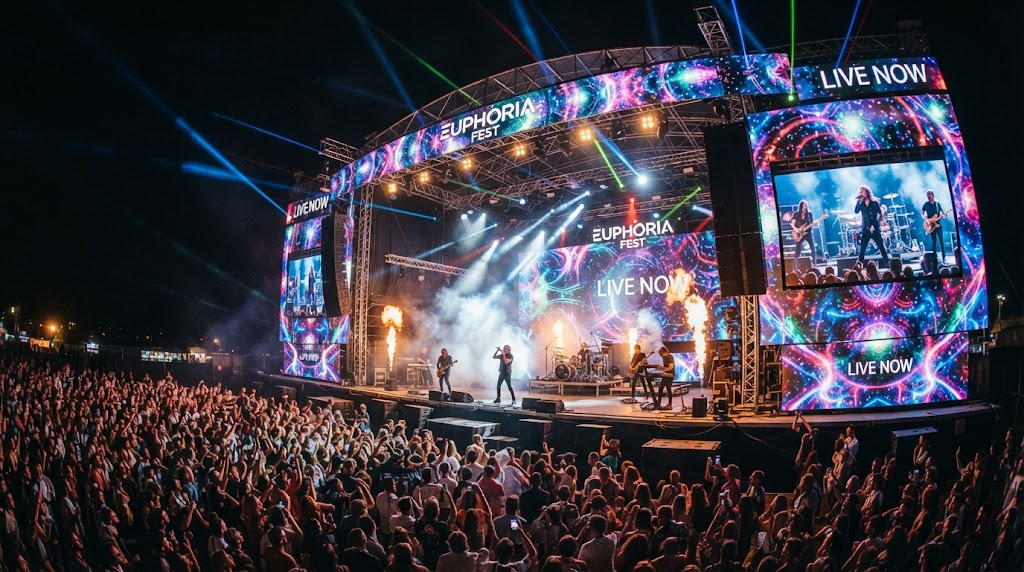
Large-scale desert deployments offer the ultimate real-world test for outdoor LED engineering. During major outdoor music festivals in Riyadh and Jeddah—including large-scale events like MDLBEAST—massive screen arrays must deliver flawless visual performance despite challenging conditions.
These temporary and permanent installations face direct desert sunlight, surface temperatures over 58°C, and sudden high-velocity dust storms.
By deploying Guanhong's IP68 fanless common cathode panels across main stage towers and perimeter digital displays, operators achieved:
Zero Dead-on-Arrival or In-Show Module Failures: Maintained a 100% operational rate across more than 1,200 square meters of active LED surface.
Consistent 8,500+ Nit Sunlight Legibility: Kept junction temperatures stable below 70°C without requiring external cooling fans or air-conditioned enclosures.
Rapid Dust Remediation: Allowed maintenance crews to pressure-wash accumulated desert dust directly off the active display surfaces between sets without powering down the screens.
TCO Analysis: Operational Life & Power Savings in Desert DOOH
While low-cost conventional displays may seem attractive initially, high-temperature deployments quickly expose their hidden operational costs. Premature component failures, higher energy consumption, and frequent technician call-outs drive up the total cost of ownership (TCO).
| Cost Vector | Standard IP65 Common Anode Display | Guanhong Fanless IP68 Common Cathode |
|---|---|---|
| Annual Power Draw (16 hrs/day) | ~185,000 kWh ($27,750 @ $0.15/kWh) | ~118,000 kWh ($17,700 @ $0.15/kWh) |
| HVAC & Fan Energy Overhead | $4,200 / year | $0 (100% Passive Convection) |
| 5-Year Maintenance Callouts | 18–25 visits (Fan replacements, dust cleans) | 1–2 routine visual checks |
| Asset Lifespan to L70 | 2.5 to 3.5 Years | 7+ Years |
| Net 5-Year Financial Impact | High Capex Replacement Required | Estimated Savings: $65,000+ per 100m² |
For fleet operators and media networks, selecting thermal-optimized, fanless hardware protects recurring cash flow and preserves display brightness for high-impact advertising.
Frequently Asked Questions: Extreme Climate Outdoor LED Displays
Why does Common Cathode technology generate less heat than Common Anode?
Common Cathode circuits supply separate, dedicated voltage rails to Red (approx. 2.8V) and Green/Blue (approx. 3.8V) diodes. Common Anode systems supply a single higher voltage (4.5V–5.0V) to all diodes, converting the unneeded voltage on the Red channel into excess heat. Common Cathode eliminates this waste, reducing panel operating temperatures by 12°C to 15°C.
How do technicians service an IP68 hermetically sealed cabinet?
Guanhong's IP68 cabinets use modular front-and-rear quick-release magnetic locking mechanisms with integrated waterproof compression gaskets. Technicians can swap individual modules in under 30 seconds using an automated vacuum service tool without breaking the weather seal of adjacent modules.
Can fanless die-cast aluminum cabinets reliably dissipate heat in 60°C ambient air?
Yes. Die-cast aluminum alloy (ADC12) has a thermal conductivity of 120–160 W/m·K—over 500 times higher than plastic. When engineered with integrated rear convection fins, the cabinet functions as a large heat sink, using natural airflow to dissipate thermal energy without mechanical fans.
How do ePTFE pressure valves protect against sandstorms?
ePTFE (expanded polytetrafluoroethylene) membranes have microscopic pores that allow air molecules to pass freely while blocking water droplets and dust particles down to PM0.1. This maintains equal pressure inside and outside the cabinet during rapid temperature changes, preventing the vacuum effect that pulls fine sand past standard rubber seals.
Equip Your High-Temperature Projects with Guanhong Display Solutions
Planning a DOOH billboard, outdoor entertainment installation, or transit display in high-heat desert conditions? Partner directly with Guanhong Display's thermal engineering team to design a display that delivers long-term reliability.
Request Middle East Climate LED Consultation
Contact our engineering desk today to download our complete Middle East & Desert Climate LED Engineering Handbook and review full third-party test reports.