
Engineering Snapshot: Direct Factory Verification
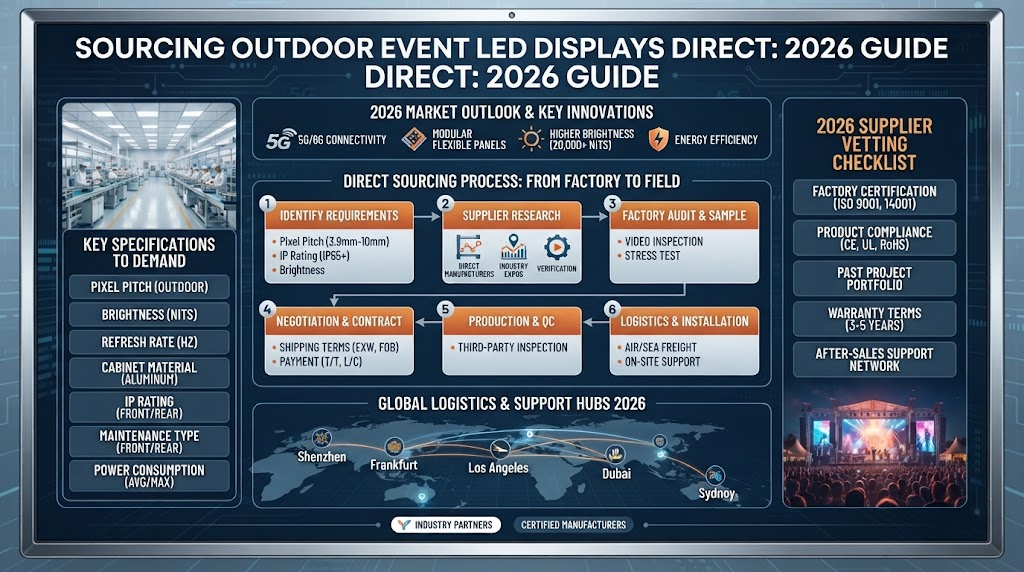
Authentic Chinese direct manufacturers of foldable LED posters maintain in-house SMT automation, proprietary multi-axis hinge tooling, and continuous cleanroom aging lines. Brokers and trading companies repackage standard white-label displays, leading to mechanical hinge sagging, trace fatigue, and optical seam gaps exceeding 0.5mm after minimal field deployment. Sourcing directly requires validating manufacturing facility licenses, precision die-cast tooling, and component-level binning traceability.
For systems integrators and commercial procurement teams, securing a reliable foldable LED poster China factory verification Homepage benchmark ensures hardware longevity across retail, corporate, and rental staging environments.

According to research cataloged by the IEEE Xplore Digital Library on flexible electronic interconnects, mechanical fatigue across cyclic flexure is the primary contributor to early interconnect failure in portable optoelectronic devices.
"Verification of genuine display manufacturing requires auditing the facility's localized capital investments: specifically high-speed SMT precision placement equipment, optical calibration gantries, and dynamic load-cycle test jigs for articulated frames."
When procurement teams evaluate wholesale LED poster China options, verifying these three tiers distinguishes an authentic OEM LED display supplier from non-manufacturing brokers trading cheap foldable LED screen hardware.
Surface Encapsulation: GOB vs Standard SMD Trade-offs
Standard Surface Mount Technology (SMT) leaves SMD diodes exposed to direct lateral shear impact. In portable, fold-and-roll use cases, frequent handling invariably shears perimeter diodes off the printed circuit board.
Glue-on-Board (GOB) utilizes a transparent epoxy or polyurethane resin cast over the surface of the SMD components. This barrier provides significant structural and environmental protection, but introduces specific engineering trade-offs:
Impact Resistance: GOB provides surface impact protection up to 8H surface hardness, protecting diodes from lateral shear during folding and transit.
Environmental Sealing: The optical face achieves IP54 front-surface ingress protection against airborne humidity, dust, and minor liquid contact.
Thermal Dissipation Penalty: The resin encapsulant adds thermal resistance, increasing diode junction temperatures (Tj) by approximately 3°C to 5°C under continuous maximum luminance.
Mass Overhead: GOB increases the net mechanical panel weight by approximately 15%, requiring sturdier base counterweights and heavy-duty gas-spring lift assists.
Rework Complexity: Field repair of individual failed diodes within a cured GOB matrix is impossible without specialized high-temperature de-bonding benches. Defective modules must be replaced at the sub-panel level.
When NOT to Specify Foldable GOB Displays
Foldable mobile LED displays are optimized for agile deployments, rapid trade-show setup, and mobile retail digital signage. They should not be selected for:
Permanent, fixed architectural indoor video walls where standard die-cast magnesium cabinets offer lower initial cost and simpler front-service access.
High-pitch viewing distances (P4 or above) or outdoor high-brightness installations requiring over 4,500 nits, where active convection and thick louvers are mandatory.
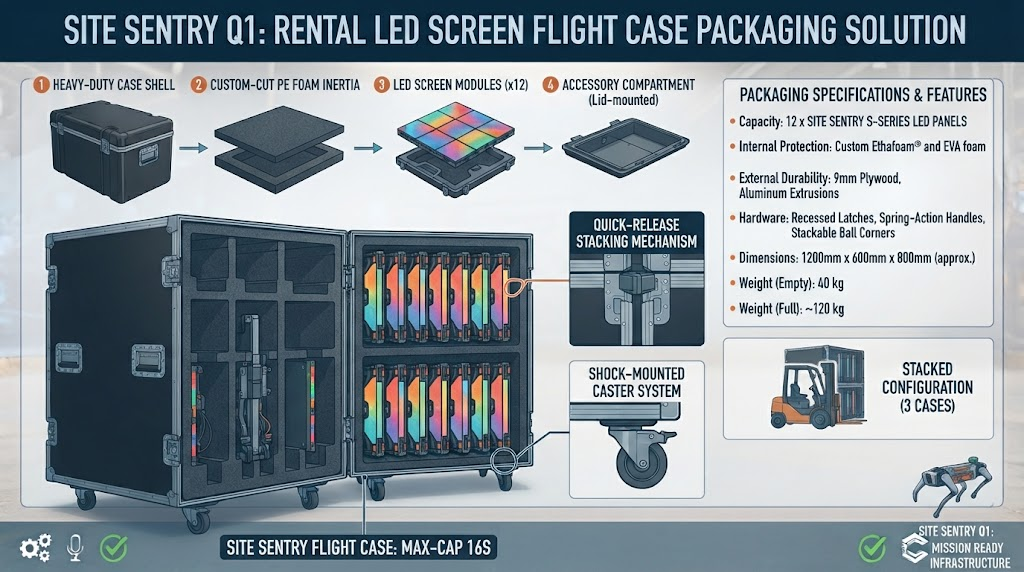
Budgets lacking allowance for modular flight-case transit storage, as improper handling negates the durability of the folding chassis.
Unmasking Hidden TCO: CapEx Realities of Low-Bid Hardware
Low-cost procurement proposals frequently mask severe operational overheads. A minimal initial CapEx often masks significant lifecycle expenditures (TCO) across a 36-month operating horizon.
Reference technical standards established by ISO (International Organization for Standardization) under ISO 9001:2015 frameworks mandate that suppliers implement documented component traceability to prevent mixed-lot assembly defects in precision optoelectronics.
Tender-Grade Factory Acceptance Test (FAT) Protocols
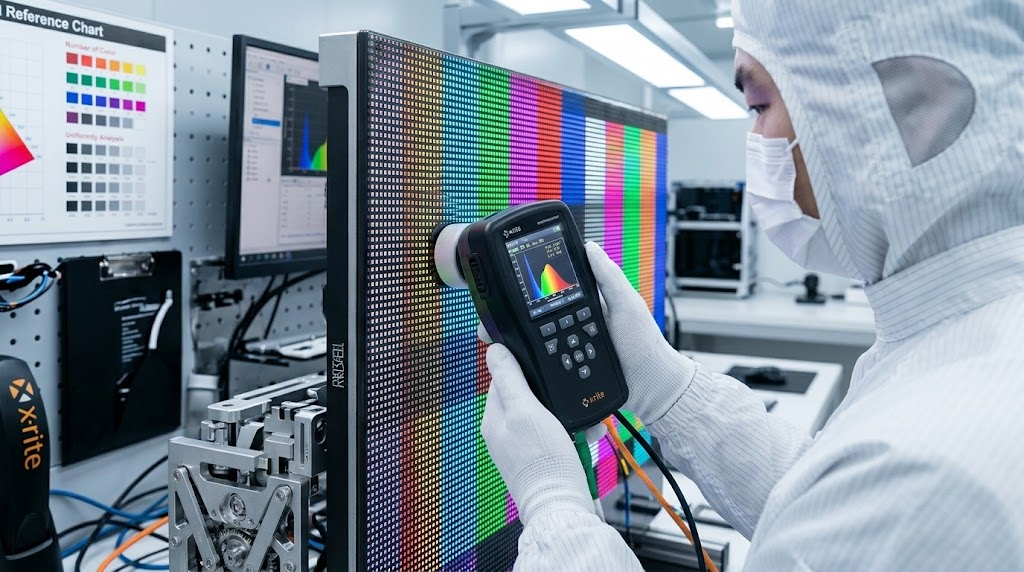
To eliminate subjective claims of quality, procurement teams must enforce measurable, contractually binding Factory Acceptance Test (FAT) criteria prior to release from the Shenzhen production floor.
Mechanical and Optical Verification Thresholds
Mechanical Seam Tolerance: With the foldable poster fully deployed and latched, the seam gap along the folding hinge must be ≤ 0.15mm across the entire vertical run. Flatness across the joint must measure ≤ 0.10mm, verified via calibrated feeler gauges.
Color Uniformity & Chromaticity Shift: Panel chromaticity coordinates (CIE 1976 u', v') measured via an optical spectroradiometer across the split fold must not exceed Δu'v' ≤ 0.003 under both 50% flat gray and 100% full-white test rasters.
Low-Gray Gamma Linearity: Drive electronics must exhibit a smooth, monotonic 16-bit grayscale ramp without stepping, contouring, or chromatic divergence down to 5% luminance.
72-Hour Continuous Aging: Panels must undergo an uninterrupted 72-hour burn-in consisting of alternating 100% full-white peak load (4 hours) and dynamic cyclic video rasters (2 hours). The dead-pixel threshold at FAT completion must be strictly under 5 ppm (parts per million), with zero cluster defects permitted.
Surge Immunity: Power supplies and logic boards must comply with the IEC (International Electrotechnical Commission) standard IEC 61000-4-5 Class 3 (Line-to-Line 1kV, Line-to-Ground 2kV surge suppression).
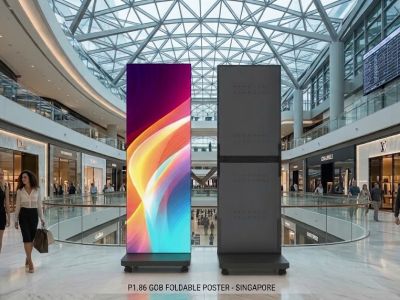
Precision Retail Sourcing: The P1.86 Dual-Axis GOB Standard
For high-frequency luxury retail deployments requiring seamless 360-degree fold-and-roll digital banners, standard white-label cabinets fail due to visible seams and diode attrition during frequent relocation. Guanhong Display engineers this exact scenario with proprietary dual-pivot aircraft-grade hinge mechanisms, integrated shock-resistant GOB surface encapsulation, and a precision-machined mechanical latching frame that guarantees seam gaps ≤ 0.15mm.
Combined with Novastar video processing and factory-calibrated single-bin LED lots, this design maintains consistent optical uniformity across multi-poster rollouts without the need for recurring on-site color recalibration.
FAQS
How can I verify if a Chinese LED supplier is a true manufacturer or a trading company?
Request the vendor's official Chinese Business License and check their 18-digit Unified Social Credit Code via the National Enterprise Credit Information Publicity System (GSXT). The "Business Scope" must explicitly state "Manufacturing, Assembly, and Production of Optoelectronic Display. If the scope only contains "Sales" or "Import and Export Trade" , they are a commercial broker. Furthermore, demand a live video walk-through demonstrating high-speed SMT assembly and calibrated optical aging racks.
What are the real environmental operating boundaries of a foldable mobile LED display?
Standard operating temperature envelopes span -10°C to +40°C. When operating in ambient conditions exceeding 35°C, continuous luminance must be derated by 1.5% per 1°C ambient increase to protect internal driver ICs from thermal runaway. Operational humidity must remain between 10% and 85% RH (non-condensing). GOB-coated optical faces achieve IP54 protection, but the mechanical chassis, folding joints, and internal power enclosures are typically rated IP30, meaning they require dry, climate-stable operating environments.
Can damaged pixels on a GOB-coated foldable LED poster be repaired on-site?
No. Individual SMD diodes sealed within a cured GOB optical resin matrix cannot be desoldered or micro-soldered in the field using conventional hand tools. Field service requires swapping out the entire modular sub-panel. True manufacturers maintain strict single-bin batch reserves and calibrate spare modules at the factory so they can be dropped into an existing chassis without visible color or brightness variations.
What warranty and spare-parts ratio should be negotiated in a direct OEM contract?
Tender-grade procurement contracts require a minimum 24- to 36-month component-level factory warranty. Ensure the initial shipment includes a contractual spare parts allocation of at least 3% to 5% replacement sub-modules from the exact same production bin, 100% spare ribbon cables and internal ZIF harnesses, and 2% spare power supply and receiving card units.