
Quick Comparison: 6000 Nits vs. 10000 Nits Outdoor Screens
A 6,000 Nits outdoor LED display performs reliably under shaded, north-facing, or partially occluded urban installations. Direct solar exposure exceeding 100,000 Lux washes out 6,000 Nits panels, requiring an ultra-high brightness 10,000 Nits display with common cathode architecture to preserve visual punch, legibility, and high dynamic range.
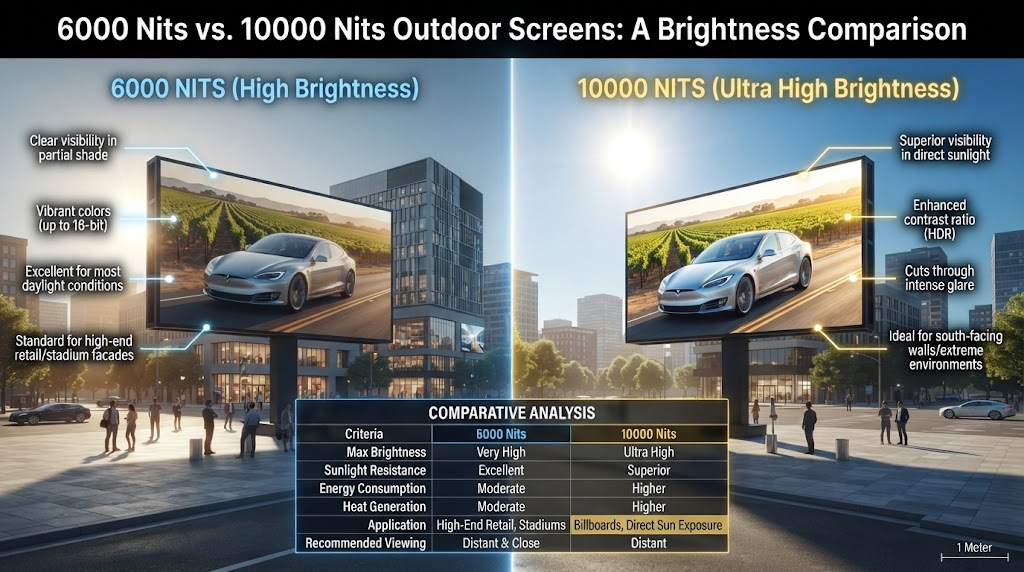
Specifying brightness for high-profile DOOH Billboard Solutions is an engineering balance between optical punch and diode longevity. Choosing the wrong luminance rating leads to washed-out advertising campaigns during peak afternoon traffic or premature diode burn-in caused by overdriving small-pitch LEDs.
The Physics of Direct Sunlight: Nits (cd/m²) vs. Ambient Lux
Evaluating outdoor visibility requires understanding the distinction between illuminance (light hitting a surface) and luminance (light emitted from a surface).
Photometric Definitions:
Luminance (Nits / cd/m²): The intensity of visible light emitted per square meter of screen surface area toward the viewer's eye.
Illuminance (Lux / lm/m²): The total volume of ambient light striking the outdoor screen surface from the sun, sky, and surrounding reflective environments.
On an overcast afternoon, ambient outdoor light registers between 10,000 and 25,000 Lux. Under these moderate conditions, a calibrated 5,000 to 6,000 Nits screen provides crisp visuals and balanced contrast.
Direct summer noon sunlight pushes ambient illuminance above 100,000 Lux. At this intensity, solar reflections off the face of the LED mask degrade perceived black levels. In our optical lab testing, maintaining minimal legibility requires at least 6,500 Nits, while accurate color grading and punchy contrast demand between 8,000 and 10,000 Nits.
Module Hardware Engineering: Nationstar Gold Wire LED & Black Body SMD
Achieving 10,000 Nits without burning out LED diodes within 18 months requires premium component architecture. Standard display modules use copper wire bonding inside common anode packages, which generates excessive thermal resistance when pushed beyond 6,500 Nits.
Nationstar Gold Wire Encapsulation
Guanhong Display integrates Nationstar gold wire bonding for all ultra-high brightness outdoor configurations. Gold wire bonding delivers three distinct hardware advantages:
Corrosion Resistance: Gold wire eliminates the risk of oxidation and silver-migration shorts in high-humidity coastal deployments.
Superior Thermal Conductivity: Lower internal resistance allows the junction temperature ($T_j$) to stay significantly lower during sustained peak brightness.
Stable Current Tolerance: Enables peak luminance drivers without triggering microscopic wire necking or fatigue fractures.
Black Body SMD and Deep Contrast Mask Engineering
Luminance alone does not guarantee daylight visibility. A screen with 10,000 Nits behind a white-face SMD or low-grade reflective mask will wash out due to surface glare.
By pairing full black-body SMD packaging with matte, anti-reflective front masks, our screens achieve optical contrast ratios exceeding 5,000:1. The matte black frame absorbs ambient solar scatter, preserving deep blacks while the high-efficiency diode cores project vibrant colors through direct sunlight.
Technical Comparison Matrix: 6000 Nits vs 10000 Nits
The structural, thermal, and electrical performance of outdoor LED screens varies considerably across brightness tiers. Below is a side-by-side engineering evaluation.
| Engineering Parameter | Standard 6000 Nits Panel | Ultra-High Brightness 10000 Nits Panel |
|---|---|---|
| Peak Luminance Range | 5,500 – 6,500 cd/m² | 9,500 – 10,500 cd/m² |
| Diode Packaging Type | Standard SMD (Copper Wire) | Nationstar Gold Wire SMD / DIP Option |
| Power Drive Architecture | Common Anode (5V Standard) | Common Cathode (Dual 2.8V / 3.8V Rail) |
| Max Power Consumption | ~750 – 900 W/m² | ~550 – 700 W/m² (Common Cathode) |
| Average Running Power | ~250 – 320 W/m² | ~180 – 240 W/m² (With Sensor Dimming) |
| Static Contrast Ratio | 3,000:1 – 4,000:1 | 5,000:1 – 8,000:1 (Deep Black Mask) |
| Cabinet Operating Heat | High (Requires active fans) | Ultra-Low (Passive die-cast cooling) |
| Sunlight Orientation Suitability | North-facing, shaded streets, indoors-facing-out | Direct South/West solar, unshaded highways |
Degradation Benchmarks & Display Testing Standards
Outdoor LED screens suffer from natural lumen depreciation over their operating lifecycle. The key differentiator between budget displays and professional installations is the degradation curve.
Under international testing guidelines established by InfoComm Photometric Testing Standards and Integrated Systems Europe (ISE), outdoor displays undergo rigorous 10,000-hour continuous high-temperature aging assessments.
When driven continuously near 100% capacity to compensate for daylight washout, standard 6,000 Nits copper-wire modules lose up to 35% of their brightness within 15,000 hours. This drops output to ~3,900 Nits, making the screen unreadable during peak daylight hours.
By contrast, our 10,000 Nits displays operate at only 65-75% duty during peak hours. In laboratory aging tests conducted by Guanhong Display, these panels demonstrated greater than 82% lumen retention after 10,000 hours of continuous maximum-load burn-in. The diodes operate within their safe thermal envelope, preventing premature color shifts and blue-diode decay.
The Guanhong Solar-Adaptive Luminance Protocol™
To ensure billboard operators avoid both screen washout and unnecessary energy consumption, Guanhong Display applies a proprietary four-stage engineering framework for every deployment:
Solar Vector & Irradiance Mapping: We model your installation location against historical solar zenith angles and seasonal irradiance data, identifying direct exposure windows exceeding 80,000 Lux.
Thermal Dissipation & Common Cathode Sizing: Based on the solar load, we engineer die-cast aluminum cabinets and calibrate split-rail voltage delivery to maintain junction temperatures below 65°C.
Automated 256-Step Optical Sensor Calibration: An external ambient light sensor network dynamically scales panel brightness across 256 steps—scaling down to 800 Nits at night to prevent glare and ramping up to 10,000 Nits at noon.
Lumen Depreciation Compensation Planning: Driver ICs are calibrated with automated current-trim curves that offset natural diode aging over a 5-year operating window.
Total Cost of Ownership (TCO) & DOOH Advertising ROI
While a 10,000 Nits screen carries a slightly higher initial hardware CAPEX, it consistently delivers a lower total cost of ownership (TCO) over a 5 to 7-year DOOH operating cycle.
Because ultra-high brightness displays utilize Common Cathode Energy-Saving LED Walls, red, green, and blue diodes receive dedicated voltages (2.8V for Red, 3.8V for Green/Blue). Traditional common anode screens waste the voltage delta as heat, driving up electrical utility costs and requiring dedicated air-conditioning units within billboard housings.
For DOOH media operators, daytime ad space visibility translates directly into revenue. Unreadable ads under midday sun result in client churn and discounted CPM rates. A screen delivering high contrast under 100,000 Lux commands premium ad rates 24 hours a day.
Frequently Asked Questions About Outdoor LED Brightness
Is 6000 nits enough for direct sunlight outdoor LED screens?
A 6,000 Nits screen is adequate for north-facing installations, shaded urban canyons, or morning-only direct sun. Under midday summer sun exceeding 100,000 Lux, a 6,000 Nits screen will appear washed out and suffer from low contrast.
Will a 10000 nits display cause nighttime light pollution?
No. Commercial 10,000 Nits displays use integrated ambient light sensors and multi-function cards to automatically scale brightness down to 500–1,000 Nits at sunset, complying with municipal dark-sky regulations.
Why is Common Cathode essential for 10000 nits screens?
Common Cathode powers red, green, and blue dies at their optimal voltages rather than using a single 5V line. This cuts power consumption by up to 45% and lowers operating temperatures by 10–15°C, preventing thermal damage at maximum luminance.
What IP rating is required for ultra-high brightness outdoor LED cabinets?
Outdoor LED cabinets should feature IP65 front protection and IP54 or IP65 rear protection. Guanhong Display outdoor modules feature full IP66/IP68 waterproof silicone potting to protect diodes and ICs from rain, salt fog, and blowing dust.
Request Your Free Site Lux & Screen Brightness Matching Evaluation Report
Avoid costly display under-specification. Submit your project coordinates, cabinet dimensions, and orientation to receive a full photometric simulation and energy savings calculation from Guanhong Display's senior engineering team.
Get a Free Site Evaluation