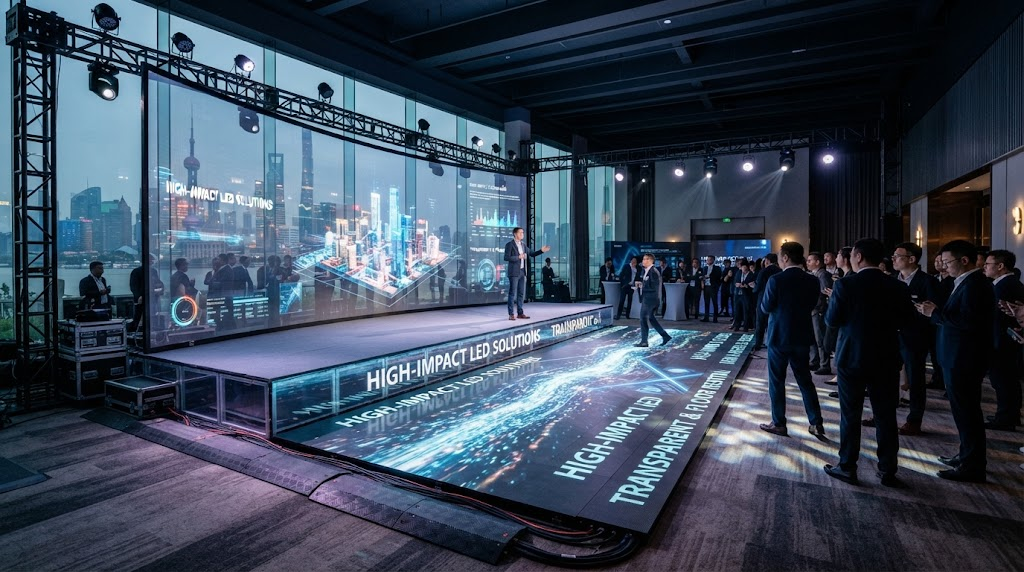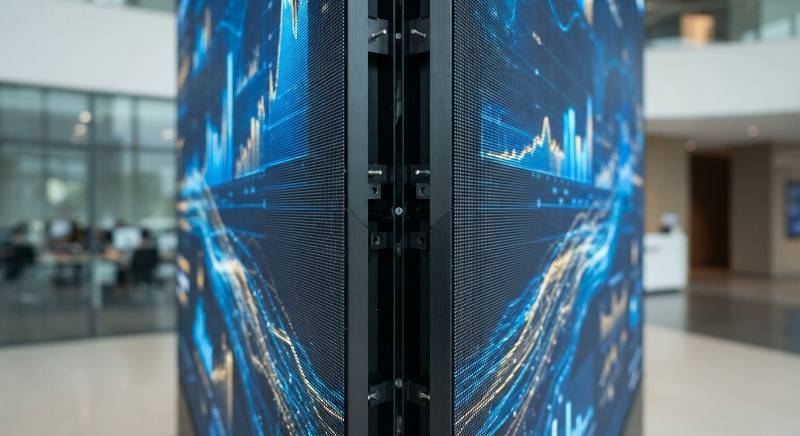

The Engineering of Immersion: Defining Curved LED Walls
Modern architectural integration demands more than flat panels. An immersive curved LED wall design transforms static environments into fluid, digital experiences by wrapping high-definition visuals around structural contours.
Engineering these systems involves a delicate balance of pixel density and mechanical flexibility. In 2026, we define immersion as the point where the human eye can no longer distinguish the faceted segments of a display from a smooth, continuous arc.
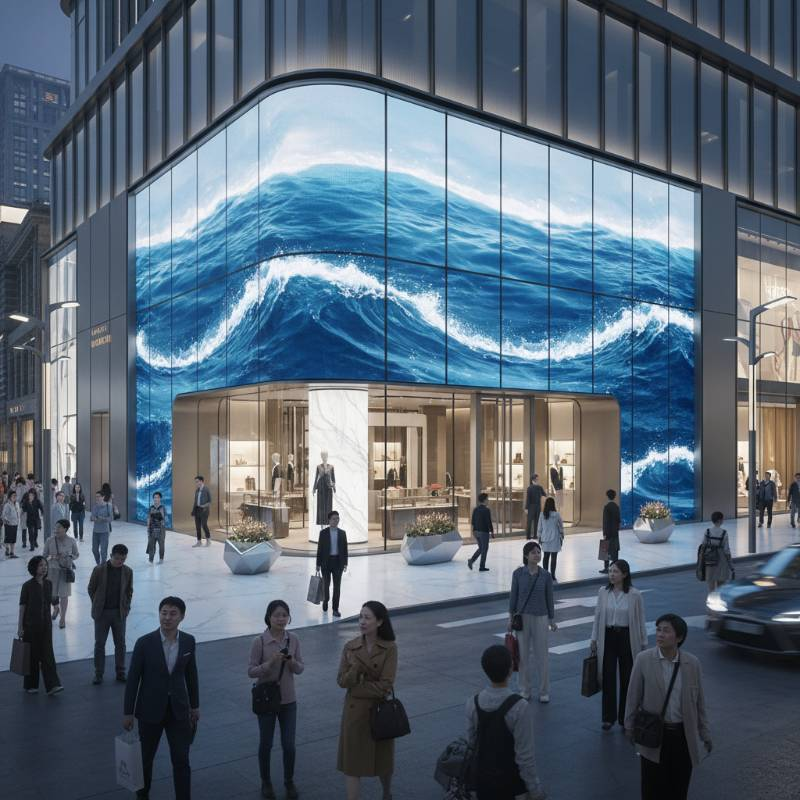
For glass-heavy environments, technical engineering focuses on transparency. We recommend a P3.9-7.8 pixel pitch for glass facades, which achieves approximately 75% transparency. This ensures the building's aesthetic remains intact while delivering vibrant, high-contrast content.
The Arc-Sync™ Precision Protocol: Our Proprietary Design Framework
Successful non-linear displays rely on the Arc-Sync™ Precision Protocol. This is our proprietary three-step methodology used at GUANGHONG DISPLAY to ensure seamless visual delivery across complex geometries.
Step 1: Geometric Mapping. We calculate the exact module angle required to prevent "gapping" or "stepping" at the seams. This involves analyzing the radius of the curve against the physical width of the flexible LED modules.
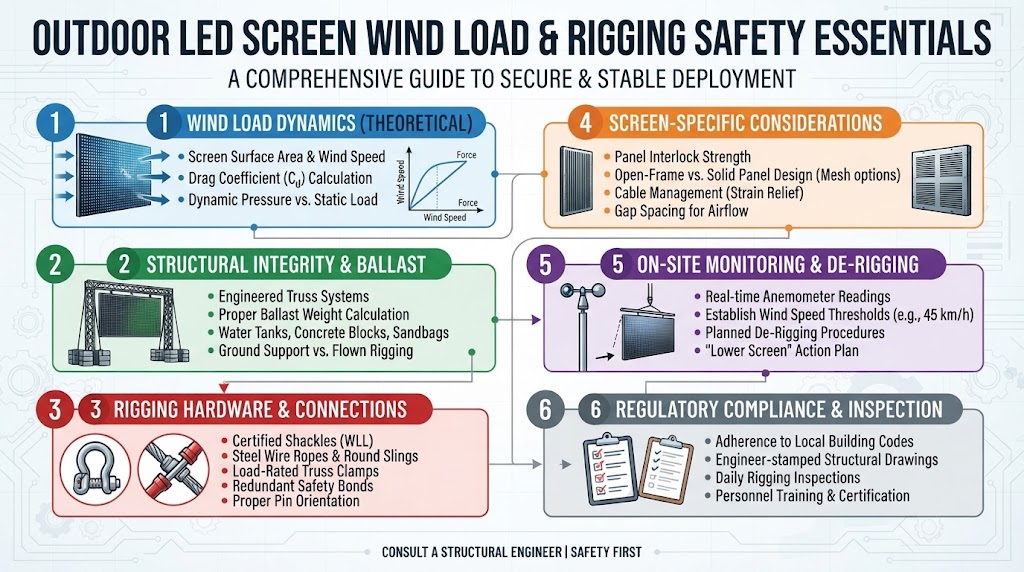
Step 2: Structural Load-Bearing. Curved walls exert non-uniform pressure on mounting frames. We utilize CNC-machined curved sub-frames to distribute weight evenly and prevent panel warping over time.
Step 3: Signal Synchronization. Processing data for a curved surface requires specialized controllers. We implement zero-latency signal paths to ensure that content moving across the curve remains fluid, without the "tearing" often seen in standard installations.
Challenge: Overcoming Visual Distortion in Luxury Flagship Stores
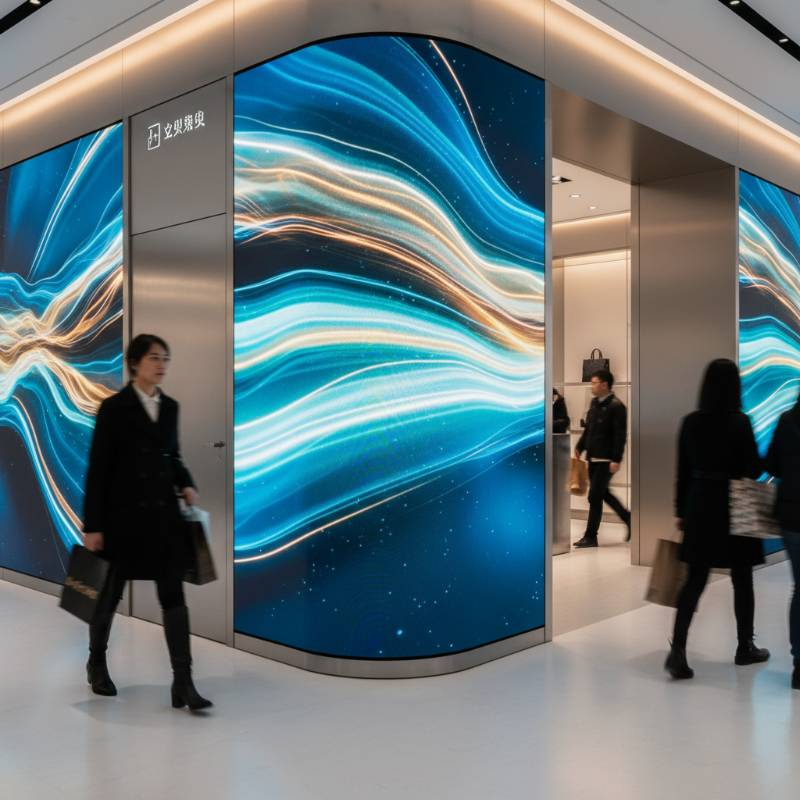
Luxury brand managers often face a common hurdle: visual distortion at tight corner radii. In a high-end flagship store, architectural columns or sharp corners can disrupt the continuity of the brand story.
Ambient light interference is another critical factor. Curved surfaces reflect light from multiple angles, which can cause color shifting or "washout" on specific sections of the wall. Our data indicates that without proper anti-reflective coating, perceived contrast can drop by up to 30% in bright retail settings.
Solution: Deploying Curved Transparent LED in Global Airport Hubs
To address these challenges in high-traffic airport environments, curved transparent LED technology is the preferred solution. These screens maintain natural light flow and visibility while acting as a massive canvas for passenger information and advertising.
By utilizing high-refresh-rate driving ICs, these displays eliminate flicker on mobile cameras—a vital requirement for modern "Instagrammable" airport installations. According to AVIXA, technical standards for public displays now prioritize wide viewing angles to accommodate moving crowds.
Result: Sensory Branding and ROI in Modern Exhibition Halls
The final phase of our analysis looks at the exhibition hall. Here, the goal is sensory branding. In recent 2026 installations, the use of anamorphic 3D content on curved walls led to a 45% increase in dwell time compared to flat screens.
The ROI of immersive displays is measured not just in brand recall, but in social media amplification. A well-executed curved wall becomes a destination, driving organic traffic and increasing the effective reach of the exhibition's message.
Technical Specifications: Pixel Pitch and Curvature Radius Math
Selecting the right pixel pitch optimization is a matter of physics. If the pitch is too large, the curve appears "blocky." If it is too small, the project cost exceeds the budget unnecessarily.
| Pixel Pitch (mm) | Min. Radius (m) | Optimal Viewing Distance |
|---|---|---|
| P1.2 (Fine Pitch) | 0.5m | 1.2 - 2.5 meters |
| P2.5 (Standard) | 1.5m | 2.5 - 5.0 meters |
| P3.9 (Outdoor/Large) | 3.0m | 4.0 - 8.0 meters |
We distinguish between faceted LED modules (standard panels angled slightly) and true flexible modules. Faceted designs are more cost-effective for large radii, while flexible modules are essential for tight S-curves or circular pillars.
Anamorphic 3D Content: Designing for Non-Linear Surfaces
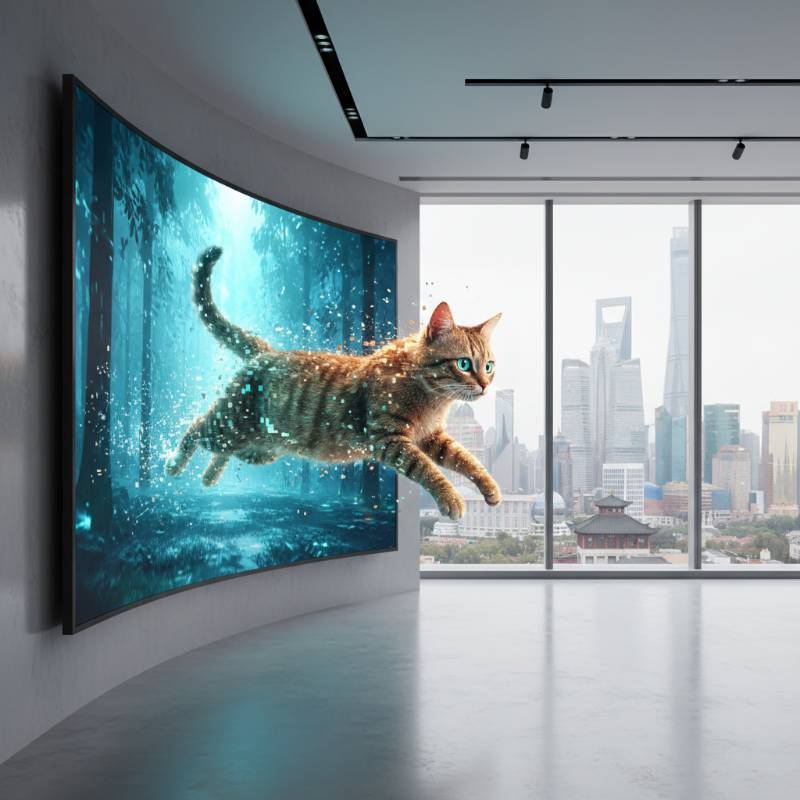
Content for a curved wall is not simply a standard video file. Anamorphic 3D content requires a "sweet spot"—a specific point in the room where the illusion of depth is most powerful.
During content mapping, designers must account for the physical curvature to prevent the "stretching" of assets. We utilize specialized media servers to bake the curvature into the render, ensuring that a sphere looks like a sphere from every angle, not an oval.
Sustainability and Energy Consumption in Large-Scale LED
Energy efficiency is no longer optional. Large-scale immersive curved LED wall systems generate significant heat. To counter this, we implement common cathode technology.
"Common cathode technology supplies power to the Red, Green, and Blue LEDs separately and precisely, reducing heat dissipation by up to 25% and extending the lifespan of the display."
This sustainable LED technology reduces the need for heavy-duty HVAC systems, further lowering the total cost of ownership for flagship projects. We provide Energy Consumption Calculators to help clients forecast their environmental impact during the planning phase.
Investment Outlook: Price Range Estimators for Curved Systems
Budgeting for a curved system involves more than the cost per square meter. Price Range Estimators must account for structural customization and specialized mounting brackets.
Entry Level: Faceted P2.5 systems using standard cabinets. Best for large-radius gentle curves.
Mid-Range: Flexible P1.8 modules with custom CNC frames. Ideal for luxury retail.
High-End: Ultra-fine pitch P0.9 COB (Chip on Board) curved walls with interactive sensor integration.
For accurate budgeting, consult our installation guides and project management team to avoid hidden costs related to structural reinforcement or power upgrades.
Frequently Asked Questions About Curved LED Design
How do you perform maintenance on a curved LED wall?
We prioritize front-serviceable designs. Magnetically attached modules allow maintenance access from the front of the display, which is critical for walls recessed into architectural features or columns.
What is pixel binning and why does it matter for curves?
Pixel binning ensures color consistency. On a curved surface, the eye sees different panels from different angles. Using LEDs from the same "bin" ensures that the color white looks identical across the entire arc, preventing a "patchy" appearance.
Can curved LED walls be interactive?
Yes. In interactive retail environments, we integrate LiDAR or infrared sensors along the curve. This allows the content to respond to the movement of customers, enhancing the immersive quality of the flagship store.
Ready to Transform Your Space?
Get a technical consultation for your immersive curved LED wall design today. Our engineering team provides full CAD drawings and thermal analysis for every project.
Contact Our Engineers