
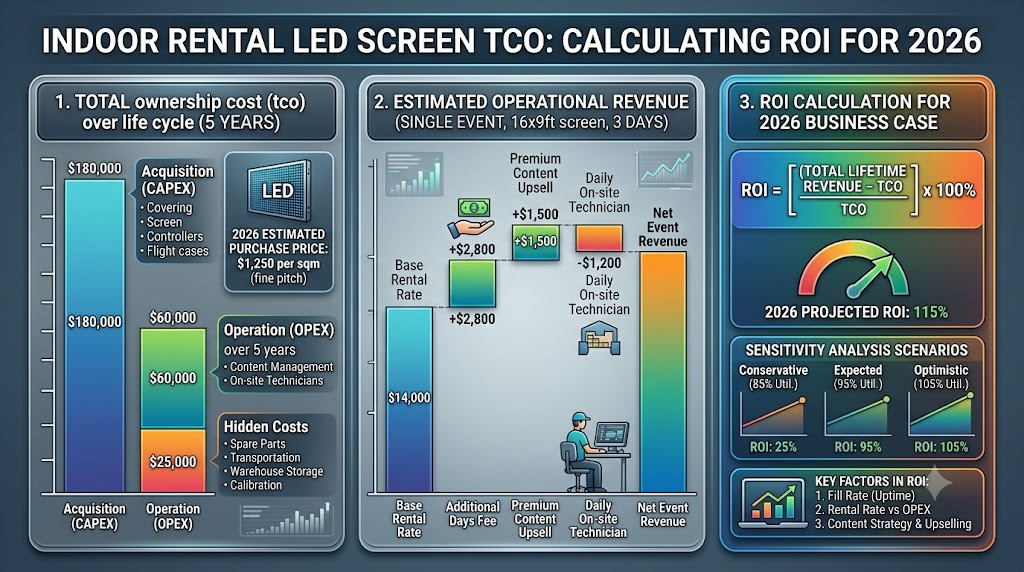
Understanding Total Cost of Ownership (TCO) for Rental LED Screens
In the high-stakes world of AV production, the indoor LED panel price is only the tip of the iceberg. True profitability hinges on understanding the Total Cost of Ownership (TCO).
As we navigate 2026, Guanhong Display defines TCO as the sum of initial capital expenditure, operational logistics, maintenance labor, and the eventual residual value of the hardware.
The GuanHong 15-Point Rental Yield Protocol
The ROI indoor rental LED screen calculation requires a shift from "purchase price" to "revenue per flight." Based on our 2026 market data, a premium indoor rental fleet achieves full cost recovery after 10 to 15 successful rentals, provided the utilization rate remains high.
We utilize the Guanhong 15-Point Rental Yield Protocol to benchmark investment success. This proprietary framework evaluates variables such as pixel pitch demand, local labor rates, and transport efficiency to predict the exact point of profitability.
For a standard Indoor LED Display Solution, the 15-Point Protocol highlights that minimizing downtime between events is more critical than the initial discount received at the time of purchase.
Technical Efficiency: From 30 Minutes to 10 Seconds
In the rental business, time is literally money. Traditional LED cabinets often require 30 minutes or more for pixel-level repairs or power supply swaps, often involving complex tools and disassembly.
"Our engineering focus for 2026 has been the elimination of technical friction. By implementing Universal Modules and Detachable Power/Control Boxes, we have successfully reduced the average onsite repair time from 30 minutes to just 10 seconds."— Chief Engineer at Guanhong Display
This "10-Second Swap" capability means a single technician can maintain a massive wall without specialized tools. This drastically lowers LED display rental business cost structures by reducing the need for highly paid on-site engineers during an event.
Standardizing on universal modules also simplifies inventory. You no longer need to stock dozens of different spare parts for different screen sizes, which further optimizes your TCO LED screen profile.
Operational Expenses: Power Consumption and Logistics
Operational costs often surprise new investors. Logistics TCO is heavily influenced by cabinet weight and flight case ergonomics. Guanhong's magnesium alloy frames are 25% lighter than older aluminum designs, reducing fuel costs and manual labor requirements.
| Metric | Standard Design | Guanhong 2026 Series |
|---|---|---|
| Cabinet Weight | 9.5 kg | 7.2 kg |
| Max Power Consumption | 800W/sqm | 550W/sqm |
| Repair Time (Module) | 20-30 mins | 10 seconds |
Lower average power consumption doesn't just save on electricity bills; it reduces the requirement for expensive power distribution units (PDUs) and heavy-duty cabling at event venues, further lowering the barrier to entry for smaller AV firms.
Technical Performance Metrics for High-End Events
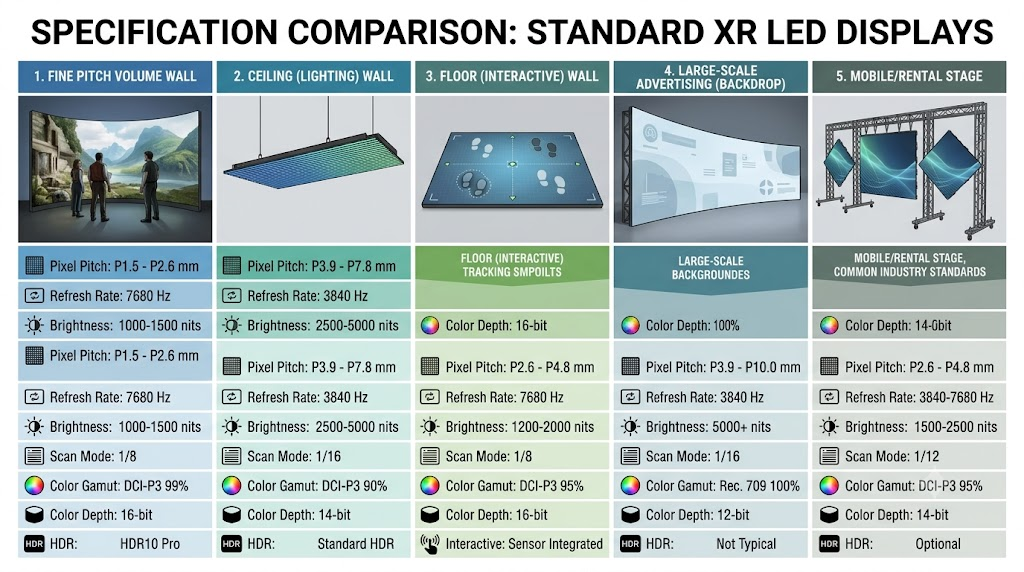
To command premium rental rates, your hardware must meet the demands of camera-ready events. This involves more than just pixel pitch; it requires high refresh rates (3840Hz to 7680Hz) and superior Nits brightness control.
We recommend consulting our LED Screen Maintenance Guide to understand how to keep your diodes performing at peak brightness over their 5-7 year lifespan.
Investing in SMD LED technology with high contrast ratios allows you to bid on corporate and broadcast projects where visual fidelity is non-negotiable. These high-end contracts typically offer 2x the ROI compared to standard retail or exhibition rentals.
Risk Mitigation: ISO9001 and the 5-Year Warranty
The greatest threat to your ROI is equipment failure. Guanhong Display mitigates this through a rigorous ISO9001 quality system. Every panel undergoes a 72-hour aging test before leaving our facility.
To further protect your investment, we offer a comprehensive 5-year extended warranty documentation package. This is not just a promise; it is a legally binding service level agreement (SLA) that ensures your fleet remains operational and profitable for its entire intended lifecycle.
According to research by AVIXA, standardized quality certifications are the #1 factor in long-term equipment reliability for rental providers.
Frequently Asked Questions
How long does an indoor rental LED screen typically last?
With proper maintenance and flight case protection, a professional-grade screen from Guanhong Display has an operational lifespan of 5 to 7 years, or approximately 100,000 hours of use.
What is the most significant factor in TCO?
While the initial price is prominent, labor and maintenance usually represent the largest variable cost. Our 10-second module swap technology is designed specifically to neutralize this expense.
Can I achieve ROI in less than a year?
Yes. If you achieve a utilization rate of 2 rentals per month at standard market rates, most Guanhong customers see full hardware cost recovery within 8 to 12 months.
Maximize Your Rental ROI Today
Ready to upgrade your fleet with the industry's most efficient 10-second maintenance technology? Contact our consultants for a custom TCO analysis.
Request a Professional Quote